








OpenAI Advises Simplifying Prompts for GPT-6 Astra, Warning Legacy Instructions Can Hinder Performance
 ·
13.09.2026 15:43
·
2 min read
·
13.09.2026 15:43
·
2 min read
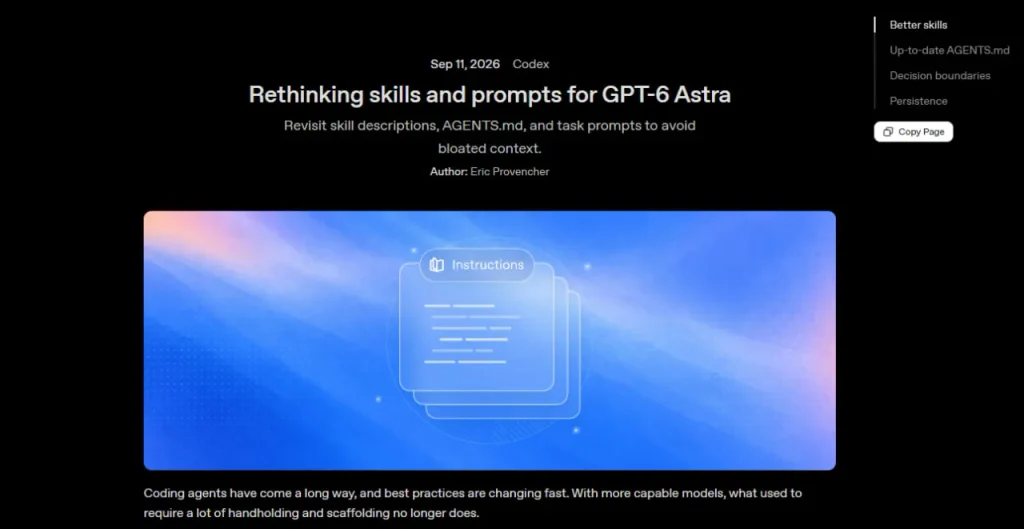
OpenAI has released an official guide for developers on adapting instructions for its flagship GPT-6 Astra model within the Codex environment. The engineers’ key takeaway sounds counterintuitive: as AI capabilities grow, users should streamline system prompts rather than make them more complex, stripping redundant rules from AGENTS.md files and attached skill libraries.
Progressive Disclosure and AGENTS.md Cleanup
In the article Rethinking skills and prompts for GPT-6 Astra, OpenAI engineer Eric Provencher explains that for years, developers compensated for weaknesses in previous AI generations with detailed step-by-step workflows. When transitioning to the more autonomous Astra, heavy, multi-page instructions become counterproductive: they clutter the context window and trigger logical conflicts.
To ensure stable performance in the development environment, the authors recommend:
- Keeping skill descriptions concise: describing the trigger mechanism briefly in the tool card is sufficient. If too many skills with bloated instructions are attached, the Codex environment automatically truncates description text, causing the model to get confused when picking tools;
- Using Progressive Disclosure: complex skills should not load dozens of documentation pages into memory upfront—the root manifest should simply point to auxiliary files that the model opens independently when needed;
- Removing mandatory full-codebase reviews: the legacy requirement to inspect all project documentation, database schemas, and deployment procedures before making minor edits is redundant. Astra can independently determine which project files are relevant to the task at hand.
Literal Interpretation of Restrictions and Auto-Auditing
A second widespread issue involves outdated safety guardrails. The new model features high alignment and interprets strict prohibitions far too literally. Rigid rules meant to curb hallucinations in older architectures lead to the agent constantly pausing tasks and asking for user permission where autonomous work was expected.
In the model interaction documentation, developers are advised to move away from micromanagement and focus on defining completion criteria instead: asking the model not just to generate code, but to run the build, verify functionality with tests, and resolve any compilation errors found.
To avoid rewriting configuration files manually, OpenAI suggests handing the task to GPT-6 Astra itself: feeding it existing AGENTS.md files for review and asking it to clean up duplicate and conflicting instructions.