




GPT-6 Astra Helps Decipher 1941 Enigma Message Unbroken for Over 20 Years
 ·
19.09.2026 15:30
·
3 min read
·
19.09.2026 15:30
·
3 min read
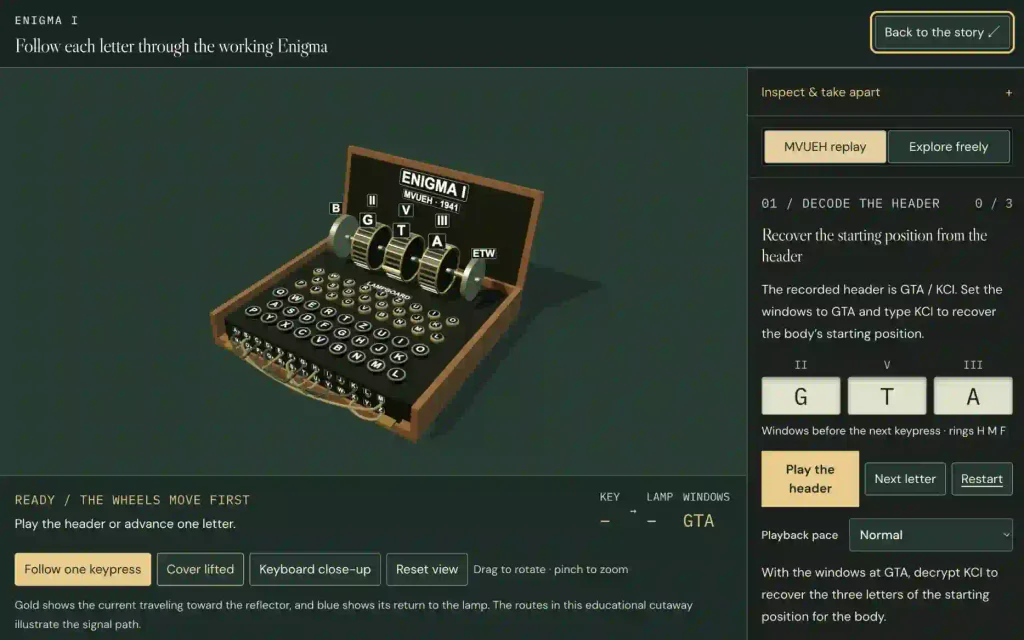
AI agents powered by GPT-6 Astra have helped recover the key and plain text of a German military Enigma message dated July 10, 1941. The message, identified as MVUEH, contains just 82 ciphertext letters and had remained unsolved in the CryptoCellar research project archive since at least 2005.
Bloomberg employee Carter Leffen spearheaded the effort, instructing GPT-6 Astra Extra High to independently review the CryptoCellar list of unsolved messages and identify a promising target. The system chose MVUEH, analyzed historical materials, compared neighboring radiograms, wrote custom code, and ran cryptanalytic experiments.
The project describes the effort as a human-led investigation using a team of specialized AI agents, rather than a fully autonomous crack. According to Leffen, the model spent about ten hours actively working, though a detailed technical breakdown spans two days—September 14 and 15—and notes that precise tracking of all model compute hours and parallel execution is unavailable.
Word Rosenow Proves to Be the Key
The primary clue came from another radiogram sent the same day, SIPVX, which was decrypted back in 2017. Its text featured the word ROSENOW twice in a row.
The agents hypothesized that the sequence ROSENOWROSENOW might also be present in MVUEH and used it as a crib—a suspected piece of plaintext that dramatically narrows the search space.
After several unsuccessful attempts, the system wrote Python and C++ programs to simulate Enigma and search for matching configurations. As a result, it successfully recovered the rotor order II–V–III, ring settings H–M–F, initial position RWD, and ten plugboard pairs.
The recovered configuration accounts for all 82 restored characters of the message as well as a separately saved header.
The decrypted text turned out to be a routine military message: the sender requested further routing instructions, reported being in Rosenow, and requested an immediate reply by radio. The text retained typos such as BTTE instead of BITTE, which researchers left uncorrected during cryptographic verification.
Enigma Researcher Validates the Solution
The result was reviewed by CryptoCellar creator and Enigma historian Frode Weierud. In a separate analysis, he confirmed that the recovered settings and plaintext match the message.
The task was complicated by errors in an older message transcription and a rare stepping of the left rotor near the end of the short message. The project team also published the code, search data, and tools required to independently reproduce the calculations.
This breakthrough does not mean AI “broke Enigma for the first time”—cryptanalytic methods for Enigma predate World War II. What makes this notable is that GPT-6 Astra was deployed not merely as a code generator, but as a team of research agents that pursued historical clues, formulated hypotheses, developed custom software, and validated the results.
Note that this was a third-party experiment rather than research published by OpenAI itself.