






OpenAI’s GPT-6 Astra Becomes First AI Model to Drive a Real Car Around a Test Track on Its Own
 ·
27.09.2026 21:41
·
3 min read
·
27.09.2026 21:41
·
3 min read
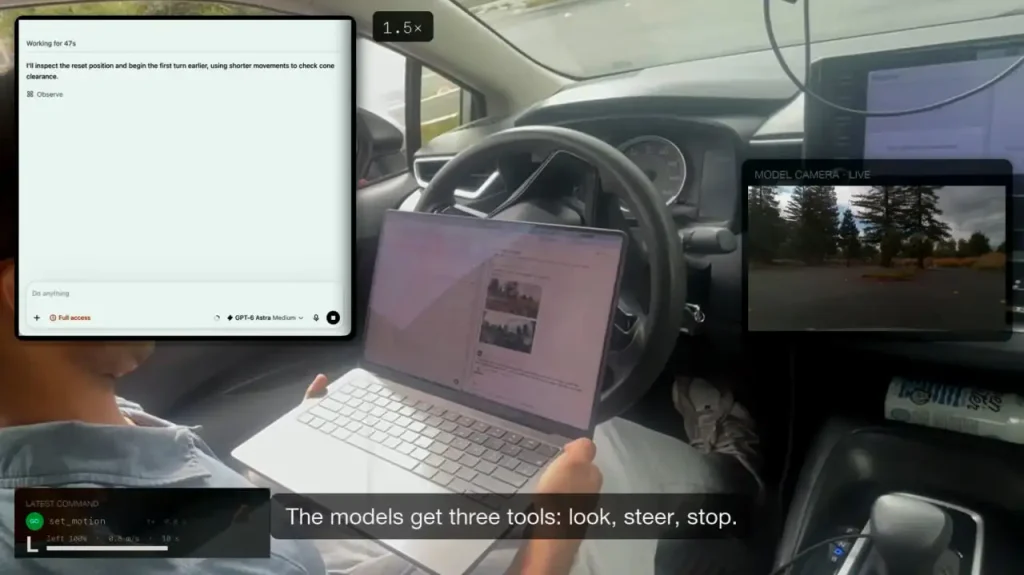
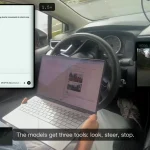
A group of independent researchers from the DrivingBench project ran an unusual experiment: they connected cutting-edge language models directly to the control system of a 2022 Toyota Corolla. Unlike traditional self-driving systems, which are trained on millions of hours of driving-specific video, the car here was driven by general-purpose chatbots relying only on analysis of camera images and basic telemetry. The clear winner was GPT-6 Astra from OpenAI — on its second attempt, it successfully completed a 134-meter course of cones in 5 minutes and 22 seconds.
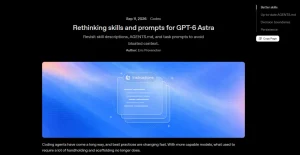
As explained in the DrivingBench report, the test did not use the usual consumer versions of the chatbots. The developers, Aditya Ramabadran, Simon Mans and Tobias Gessler, wrote special integration code: GPT-6 Astra and GPT-5.6 Sol ran through the Codex environment, Claude Fable 5.1 through Claude Code, and Grok 4.6 addressed the car using the Cursor editor.
Three commands for the steering wheel and a mandatory safety driver
To hand the AI control of the steering, gas and brakes, the researchers connected a comma four device running the open-source openpilot software to the car’s CAN bus. The models were given a tightly limited API with just three actions: get a camera snapshot and the current speed, set a motion vector (steering angle, speed and pedal press duration), or perform an emergency stop.
Driving in real city traffic was never on the table. The experiment took place in an empty parking lot in the San Francisco Bay Area, and speed was artificially capped at a safe range of 1.8 to 12.6 km/h. As a safeguard, a person stayed behind the wheel at all times, ready to hit the brake and take over at any moment, The Register notes.
We gave ChatGPT, Claude, and Grok control of a real Toyota Corolla 🚗, steering/gas/brakes, no human driving (just a foot over the brake).
— DrivingBench (@DrivingBench) September 21, 2026
Only one model was able to complete our entire driving course. Introducing DrivingBench. 🔥⌛️🏁 pic.twitter.com/HhukXrByus
Learning from mistakes on the fly and the cost of an AI driver
The OpenAI model’s competitors failed the task. In its best attempt, Claude Fable 5.1 covered 45% of the route, Grok 4.6 stopped at 11%, and GPT-5.6 Sol drove only 6% of the way. Most of the algorithms struggled with spatial perception and knocked over cones on the very first turn.
GPT-6 Astra’s main breakthrough was its ability to adjust its behavior based on its own experience without additional fine-tuning. On its first run, the model went off course halfway through the track. After analyzing the logs of that failure, on the second attempt the neural network decided on its own to drive more slowly, began requesting camera updates more often, and started using maximum steering angles to get through difficult sections.
Despite the impressive result, generative models are not yet ready to replace specialized autonomous driving systems. Astra’s successful five-minute run cost the researchers 6.6 million tokens, which came to $7.74 just for processing the requests. Scaled to real distances, that works out to about $92 per mile driven.
The DrivingBench project proved that modern multimodal models have enough spatial reasoning to navigate the physical world. However, using them as an actual driver on public roads remains too slow and prohibitively expensive for now.