








Perseverance Explores Mars’ ‘Wild West’: Ancient Rocks and a New Use for the Ingenuity Processor
 ·
01.10.2026 18:06
·
3 min read
·
01.10.2026 18:06
·
3 min read
NASA’s Perseverance rover has reached one of the most intriguing geological sites of its five-year mission. The science team has nicknamed the area Lac de Charmes, beyond the western rim of Jezero Crater, Mars’ “Wild West.” Here the rover found the oldest rocks yet, formed during the intense asteroid bombardment of the young planet. To speed up navigation across the rugged terrain, engineers reprogrammed the communications processor from the now-defunct Ingenuity helicopter.
Until now, Perseverance had mostly studied sedimentary rocks inside Jezero Crater, laid down billions of years ago on the beds of rivers and lakes. The ridges and valleys of Lac de Charmes represent a fundamentally different chapter of Martian history. The local rocks date back to the earliest era of rocky planet formation in the solar system.
On Earth, rocks of that age are nearly impossible to find. Our planet’s surface is constantly renewed by shifting tectonic plates. Mars, by contrast, cooled long ago and lost active tectonics, so it has become an ideal geological preserve that retains its primordial crust.
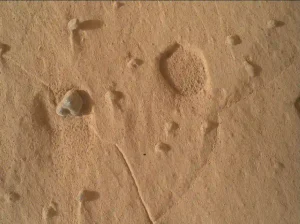
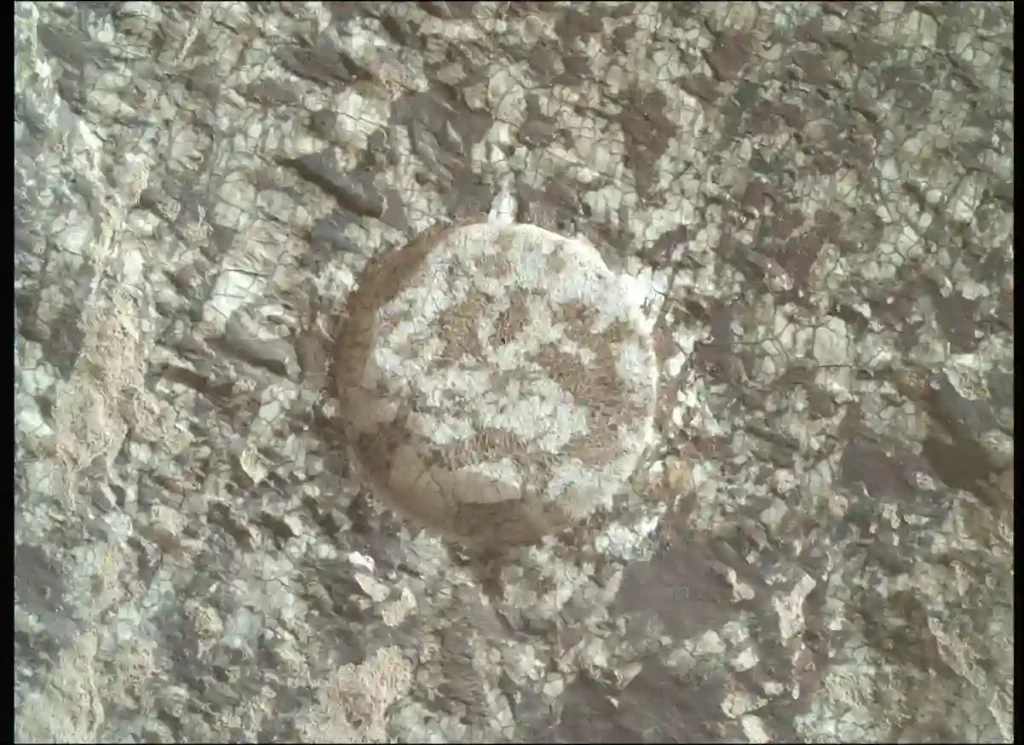
While working in the new zone, the rover has already drilled 13 abrasion holes, scraping away the top layer of dust and oxides. Analysis showed that some of the rocks are purely magmatic in origin, while others are impactites — rocks fused by the enormous pressure and heat of meteorite strikes. Some samples show traces of both processes at once.
A hardware upgrade and a nut too tough to crack
An unusual technical trick helps the rover maneuver among the ridges of the “Wild West.” After the Mars helicopter Ingenuity damaged its rotor blades and ended its historic mission, Perseverance was left with an idle but powerful processor that had handled radio communications with the drone. NASA engineers rewrote the software and handed the chip’s computing power to the rover’s autonomous navigation algorithms. That lets the heavy vehicle plot longer, more precise routes without constantly waiting for commands from Earth.
The initial survey of the area is now winding down, but it hasn’t been without setbacks. At a recent stop in the Idubi zone, the rover came across a field of hundreds of light-colored boulders. After choosing a rock with an unusual contrasting texture, engineers tried to take a full core sample from it, but the rock turned out to be too hard. The drill mechanism couldn’t handle the job, and the team is now looking nearby for a slightly softer rock to sample.
Perseverance’s next target will be the Gardenia rock outcrop. Scientists hope it is a breccia — a complex rock packed together from fragments of many other, even older Martian stones.