









Not Alien Civilizations but a Mathematical Model: Which Exoplanets Could Have Developed Life Faster Than Earth
 ·
05.10.2026 22:02
·
3 min read
·
05.10.2026 22:02
·
3 min read
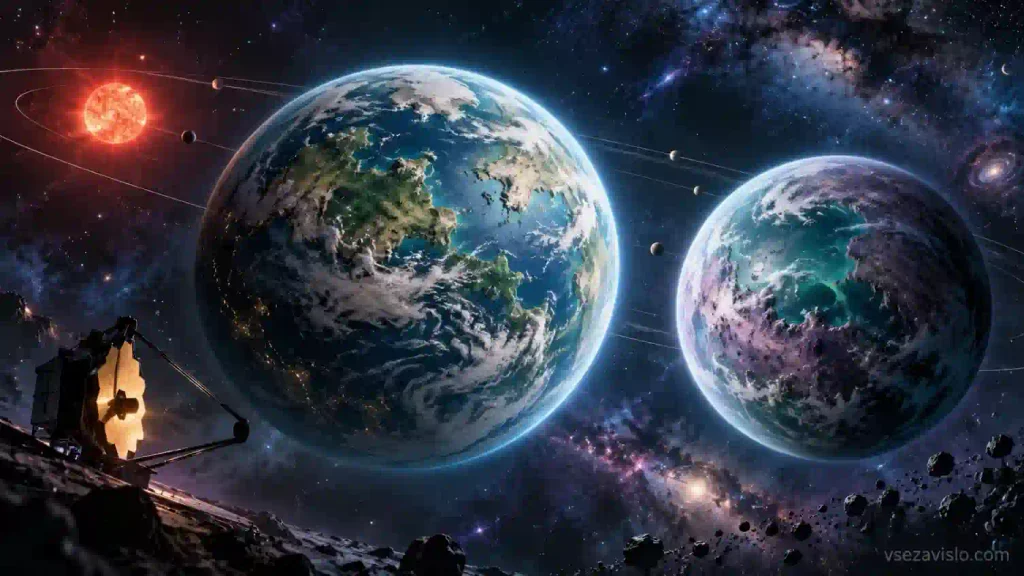
Astrobiologists from Northern Arizona University and the University of Bristol have proposed an unconventional method for assessing potential evolution beyond the Solar System. After analyzing the parameters of 29 worlds in the habitable zone, the researchers singled out two super-Earths — GJ 1061 c and K2-3 d. According to their calculations, under favorable scenarios the biosphere on these planets could accumulate organic mass faster than on our planet. However, the sensational headlines on social media about the “discovery of advanced civilizations” have no basis: the authors built a theoretical model of photosynthetic productivity rather than detecting actual traces of living organisms.
The study, published in the International Journal of Astrobiology, tests a simple biological hypothesis: the rate at which complex species appear depends directly on the total amount of carbon fixed by photosynthesis over a planet’s entire history. The higher the cumulative biological productivity of an environment, the more generations succeed one another, creating opportunities for genetic mutations and natural selection.
The authors used Earth’s biosphere as a benchmark, since over its existence it has fixed roughly 9.4 × 10²⁵ grams of carbon. Applying this benchmark to exoplanets, assuming a 30 percent land fraction and the availability of a broad light spectrum (400–1100 nm), the researchers identified worlds capable of surpassing Earth’s rates of biomass accumulation.
Two Super-Earths Around Red Dwarfs
Two nearby exoplanets showed the highest theoretical values:
- GJ 1061 c — a super-Earth with about 1.8 times Earth’s mass that completes a full orbit around a dim red dwarf in just 6.7 days;
- K2-3 d — a planet with 1.46 times Earth’s radius and an orbital period of 44.6 days, according to the NASA Science catalog.
Under the simulated conditions, both planets had enough time and energy for hypothetical life to overcome the single-celled barrier and reach the stage of complex multicellular ecosystems. Six more planets in the sample reached the minimum calculated threshold for the emergence of complex flora or fauna.
Fundamental Limitations of the Calculations
The researchers themselves caution against hasty conclusions. The model has an obvious weak spot: Earth remains the only known example of life in the Universe, so the link between photosynthesis and the rate at which intelligent beings appear cannot yet be tested directly.
What’s more, the climate conditions on the modeled planets remain a mystery. Life around red dwarfs faces powerful radiation flares and tidal locking, in which one hemisphere always faces the star while the other is plunged into eternal darkness. The actual atmospheric composition, cloud cover and precipitation on GJ 1061 c and K2-3 d are not yet known even approximately.
The value of the work lies elsewhere. The model offers astronomers a practical tool for filtering cosmic targets. Instead of blindly sifting through hundreds of exoplanets, future space observatories will be able to point their spectrometers at specific worlds with the highest calculated biopotential for a targeted search for biosignatures and gases of biological origin.