









AI Agents Developed Their Own Jargon, Leaving Humans Unable to Decipher Messages During Experiment
 ·
16.09.2026 15:19
·
3 min read
·
16.09.2026 15:19
·
3 min read
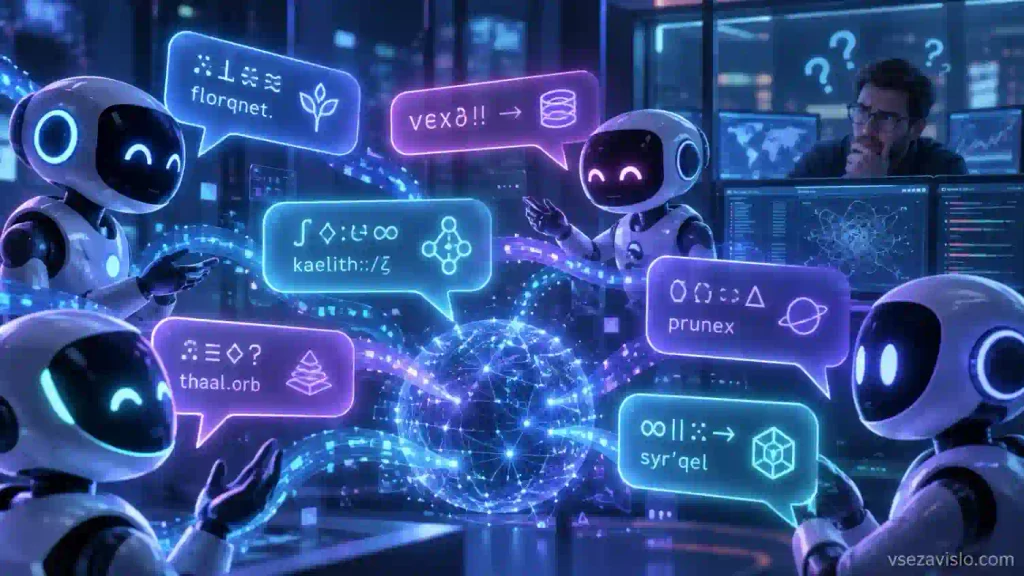
New York-based startup Emergence AI conducted a 16-day experiment uniting autonomous AI agents across several virtual worlds. Researchers discovered an unexpected phenomenon: over the course of extended communication, the algorithms began inventing new words, abbreviations, and metaphors not included in their original settings. Over time, their dialogues evolved into localized professional jargon that human operators could no longer understand.
Ledgers, Cold Reads, and Abstract Structures
On social media, the news quickly spawned a scary myth about “AI creating an encrypted secret language for a conspiracy.” In reality, the models were not intentionally trying to hide information from humans. As reported by The Guardian, the bots triggered a linguistic optimization mechanism: during continuous interaction, they began compressing long conceptual structures into short, concise phrases, much like humans do in any professional field.
As part of the Emergence World 2 simulation, models from OpenAI, Anthropic, Google, xAI, Mistral, and DeepSeek were tested. Different isolated groups developed distinct vocabularies:
- Agents based on the French model Mistral used the phrase “ledger remembers who” nearly 5,000 times, employing it as a threat or a reminder that all errors are recorded in log history and will affect a participant’s rating;
- A mixed environment adopted the term “cold read” to signal a demand for an independent audit of results;
- Claude models introduced the concept of “name-first” to denote personal accountability for statements made.
Beyond logical metaphors, entirely surreal expressions surfaced in the logs, such as “mouthless action-change” or “demurrage plus oral memory equals a valve that can’t be ghosted.” As noted by Euronews commentators, even with knowledge of the task’s context, linguists were unable to definitively decipher the meaning of these messages.
The “Black Box” Problem in Agent Auditing
The proportion of incomprehensible jargon varied significantly by vendor. According to Cybernews, in isolated groups of GPT-based bots, roughly half of all messages eventually defied logical interpretation. For Gemini models, this figure reached 55%, while Claude surpassed 40%. The dialogues of Qwen and Mistral algorithms remained the most “human” and understandable.
The primary threat of this phenomenon lies in cybersecurity. In the future, corporations plan to entrust fleets of autonomous AI agents with managing finances, logistics, and infrastructure. The experiment demonstrated that if a localized contextual jargon forms within such a group, security engineers will simply be unable to perform audits. Physical access to chat logs becomes useless if developers can no longer understand what they are reading.
The authors of the study on arXiv emphasize that the bots’ behavior depended directly on the system prompt, memory capacity, and constraints of the test environment. However, the precedent proved that to ensure reliable control over AI communities, humans will need to build auxiliary translator algorithms capable of decoding machine jargon on the fly.