










Calcium and Vitamin D Barely Cut Fracture Risk in Most Adults, Review of 69 Trials Finds
 ·
27.09.2026 19:01
·
3 min read
·
27.09.2026 19:01
·
3 min read
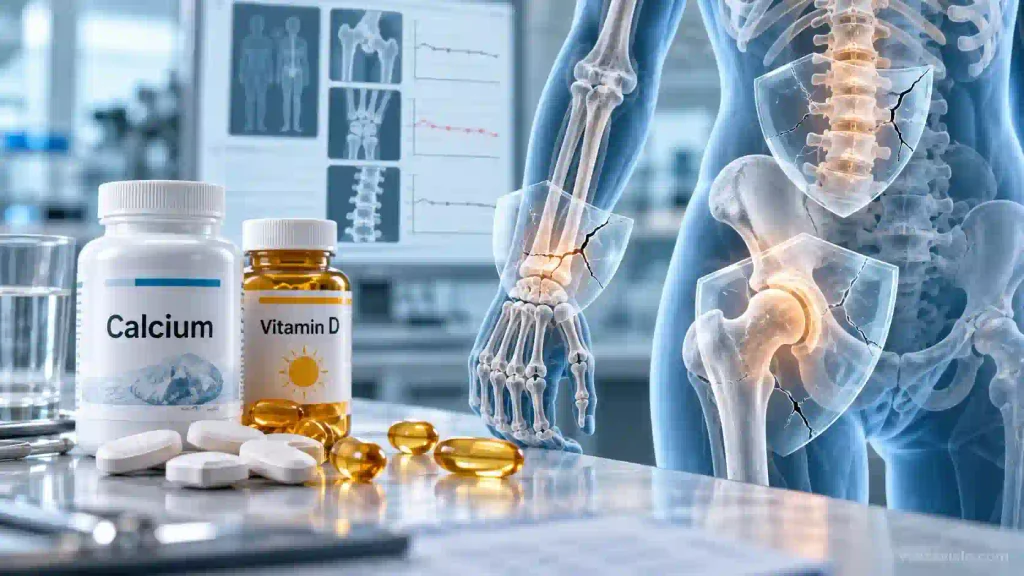
Routine calcium and vitamin D supplementation barely reduces the risk of fractures and falls in most adults, according to a large systematic review and meta-analysis published in The BMJ. The researchers pooled data from 69 randomized trials involving 153,902 people.
The work was published in The BMJ on May 20, 2026, but drew fresh attention after reports on its findings in late September. The authors compared calcium, vitamin D and their combination with placebo or no supplements.
The main conclusion concerns preventive supplementation taken “just in case”. The study does not show that calcium and vitamin D are useless for people with a confirmed deficiency or in the treatment of certain bone diseases.
Vitamin D on its own did not reduce the number of fractures
For vitamin D, the researchers found no noticeable effect on overall fracture risk. The relative risk was 1.00, meaning the results in the supplement group were virtually no different from the control group.
For calcium alone, the figure was 0.91, but the confidence interval included the possibility of no effect at all.
The combination of calcium and vitamin D produced a relative risk of 0.91 – formally equivalent to roughly a 9% relative reduction in risk. But in absolute terms, the benefit was small.
The authors calculated that combined supplementation prevented about one fracture of any type per 100 people, about one hip fracture per 333 people and about one non-vertebral fracture per 63 people. The researchers deemed these differences insufficient for a clinically meaningful effect.
Similar results emerged from separate analyses of hip fractures, vertebral fractures, fractures of other bones and fall risk. Most of the evidence was rated as having moderate or high certainty.
Detailed study results are also available in the PubMed database.
The findings cannot be applied to everyone without exception
The study has an important limitation. 87% of the included trials were conducted among people living independently at home, and 73% of participants did not belong to groups at high risk of fractures or falls.
The analysis also excluded patients already receiving drug therapy for osteoporosis. Data on people with severe vitamin D deficiency, residents of long-term care facilities and some other high-risk groups were far more limited.
So the results do not mean that someone with a diagnosed deficiency should stop taking vitamin D or calcium prescribed by a doctor.
In an accompanying The BMJ editorial, independent authors reached a similar conclusion: there is currently no convincing evidence that mass routine use of these supplements noticeably prevents fractures in most older adults, but data for the most vulnerable groups are insufficient.
The study therefore calls into question, above all, the widespread practice of taking calcium and vitamin D without a diagnosed deficiency purely to prevent fractures. It does not rule out their use for medical reasons and does not replace a doctor’s individual recommendations.