









Designer Creates ‘Digital Camouflage’ to Hide Humans from Computer Vision Algorithms
 ·
28.08.2026 20:29
·
2 min read
·
28.08.2026 20:29
·
2 min read
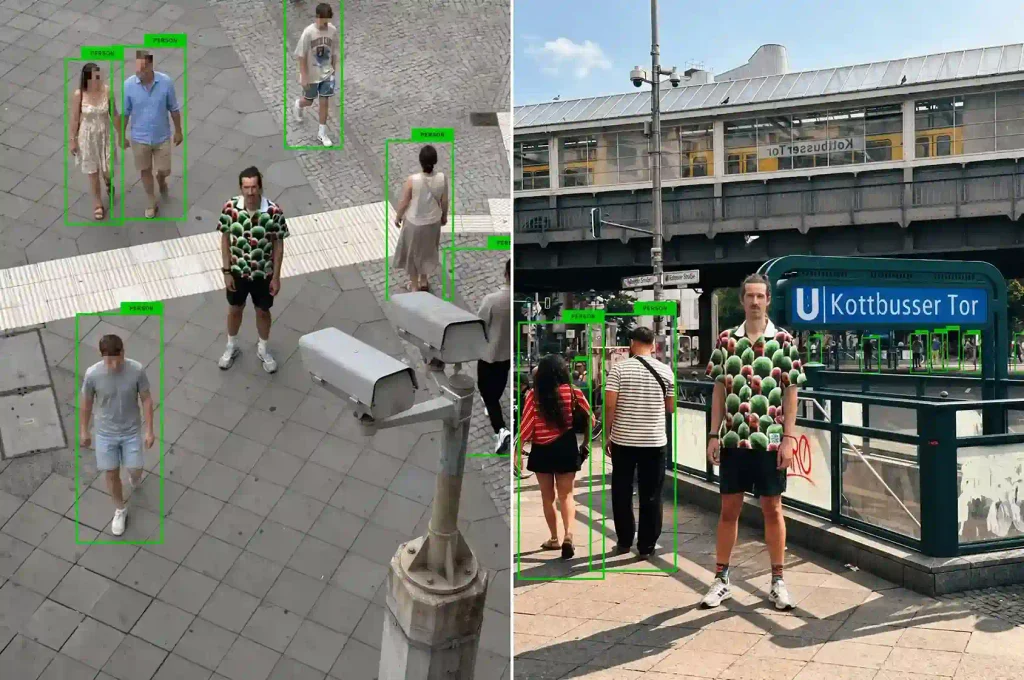
German artist and researcher Simon Weckert has unveiled Digital Camouflage, a Hawaiian shirt featuring a custom generative print designed to confuse machine vision systems. During testing, detection algorithms failed to recognize the wearer as a human, while continuing to track all other pedestrians in the frame.
AI vs. AI: How the Adversarial Pattern Was Created
At first glance, the shirt looks like standard vibrant apparel with an abstract geometric pattern. However, the selection of shapes, contrasts, and color spots was developed using an adversarial loop.
As explained by CreativeApplications, the generation process followed this principle:
- a neural network created a print variant;
- the design was tested against machine vision models to check the detector’s confidence level;
- the algorithm made micro-adjustments to contrast and shapes until the probability of human detection fell below a critical threshold.
Essentially, one AI helped shape a camouflage pattern to deceive another AI.
The Mechanics of Optical Deception
Modern object detectors do not perceive images holistically like humans do. Neural networks calculate statistical patterns: the ratio of shoulder and head lines, silhouette geometry, light-shadow transitions, and textures.
The complex Digital Camouflage print fragments the visual contours of the torso. As noted by PetaPixel, the algorithm can no longer combine these disparate visual markers into a single “person” class. In demonstration videos, target bounding boxes consistently appear around all other pedestrians, while the person wearing the shirt remains “invisible” to the system.
Silhouette Detection vs. Face Recognition: Key Limitations
On the project’s official website, the author explicitly outlines the technical scope of the experiment:
- Protection works against detection systems: the camouflage was tested on the popular open-source YOLO architecture, which is designed for initial object detection in a frame;
- It is not a Face Recognition blocker: if the optics focus on an exposed face, a specialized biometric algorithm will still be able to perform identification.
The project was inspired by the deployment of a “smart” video surveillance system at Kottbusser Tor in Berlin, where approximately 30 cameras monitor the area using behavioral analysis. Weckert emphasizes that his work has not been tested against closed-source government police software, so Digital Camouflage remains primarily an artistic statement on privacy rather than a guaranteed method for evading surveillance.