








iPhone 17 Pro Dropped From Stratosphere at 30.6 km: Phone Survives and Sets Guinness World Record
 ·
28.08.2026 20:23
·
2 min read
·
28.08.2026 20:23
·
2 min read
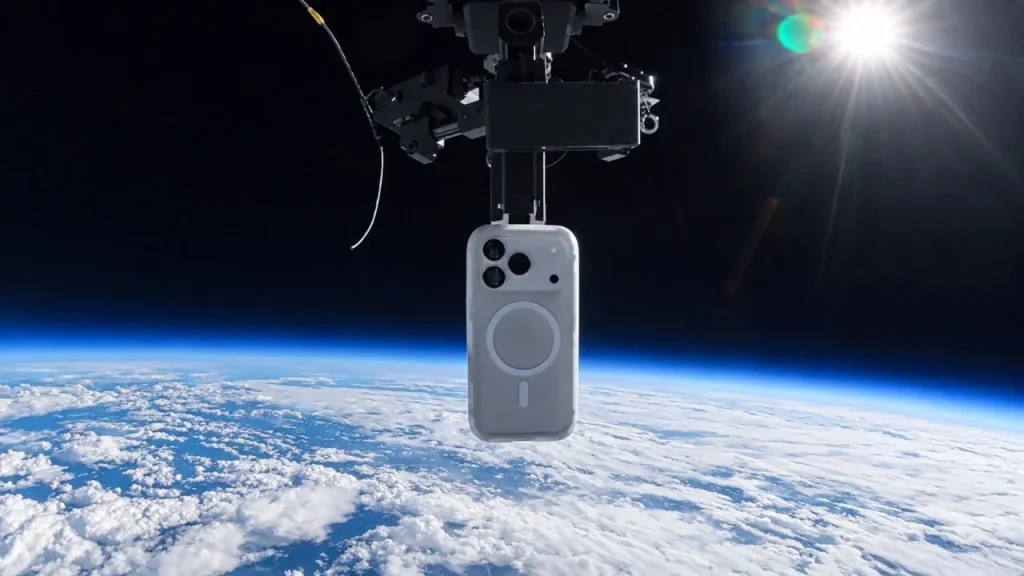
The flagship iPhone 17 Pro inside a standard production RHINOSHIELD AirX case has successfully survived a fall from an altitude of 30,607 meters. After a 25-minute descent from the stratosphere and an impact with natural ground, the device remained fully functional, and the experiment was officially entered into the Guinness World Records.
Near-Space Experiment
The drop test took place in Sweden near the Esrange Space Center in Kiruna. Protective accessory manufacturer RHINOSHIELD conducted the launch in partnership with British aerospace firm Sent Into Space.
The smartphone was mounted on a stratospheric balloon and lifted above 100,000 feet (30.6 km) — roughly three times higher than the cruising altitude of commercial airliners.
During the 25-minute fall, the device was exposed to a severe combination of extreme environmental conditions:
- ambient air temperatures dropped to between −40 and −60 °C;
- atmospheric pressure was only about 1% of sea-level normal;
- no active heating or sealed thermal enclosures were used to protect the electronics.
Condition After Landing
After locating the smartphone via GPS beacon, representatives from Guinness World Records conducted a detailed inspection of the device.
As stated in the event’s press release, the iPhone 17 Pro suffered no visible mechanical damage to its body or display, powered on normally, reconnected to a wireless network, placed a phone call, and took a series of photos. The achievement was recorded under the category “Highest drop of a mobile phone in a phone case onto a natural surface.”
Engineering Details and Drop Physics
The official record protocol specifies that the smartphone did not drop completely isolated: it was secured to a lightweight test rig with payload cameras and a small drogue parachute (drogue chute). The chute was used not for a soft landing, but for aerodynamic stabilization — ensuring the test assembly fell at the exact same terminal velocity as a standalone phone in free fall.
As the descent progresses, air density increases, and the falling object rapidly reaches its terminal velocity, where atmospheric drag balances gravitational acceleration.
The main impact upon contacting the ground was absorbed by the case. According to the RHINOSHIELD AirX specifications, the design features deformable air micro-chambers capable of absorbing and dispersing up to 81% of kinetic impact energy around the perimeter.