










E-scooters are more dangerous than motorcycles for the head: hospitalized riders suffer TBI 3.5 times more often
 ·
21.08.2026 08:03
·
2 min read
·
21.08.2026 08:03
·
2 min read
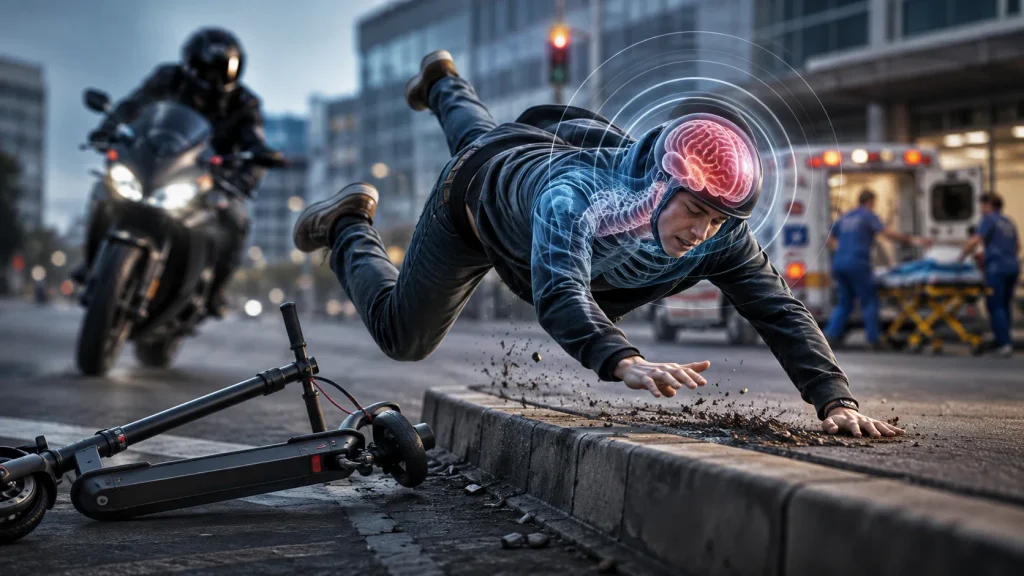
Hospitalized e-scooter riders suffer severe brain, vascular, and internal organ injuries far more often than injured motorcyclists and cyclists. That’s the conclusion of British researchers in a large-scale study published in Scientific Reports.
The scientists analyzed 15,247 records from the National Trauma Registry of England and Wales (including 580 scooter riders, 7,027 motorcyclists, and 7,640 cyclists), as well as data from 23,000 incidents involving rental scooters, covering over 33 million trips.
Injury patterns: the impact hits the head
Among adult patients admitted to hospitals with severe injuries, the distribution of injuries among e-scooter riders showed a sharp skew:
- Traumatic brain injuries (TBI) occurred 3.45 times more often than in motorcyclists and 1.74 times more often than in cyclists (on average, about 36 TBI cases per 100 injured);
- Vascular injuries occurred 3.24 times more often;
- Internal organ damage — 1.46 times more often;
- Bone fractures, on the other hand, occurred 20% less often than in motorcycle accidents.
Among e-scooter casualties, the proportion of minors was high — 16.2% compared to 6.2% for motorcyclists. In children, traumatic brain injuries were even more frequent — nearly 43 cases per 100 hospitalizations.
Why e-scooters are so dangerous
The researchers highlight two key reasons for this severe injury profile:
- Almost complete disregard for protection: only 5.9% of injured scooter riders wore a helmet. For comparison, among injured motorcyclists, 75.7% used protective gear, and among cyclists — 45%.
- Physics of movement and design: the rider’s upright stance creates a high center of gravity, and small wheels lock up instantly when hitting potholes, rails, or curbs. During a sudden stop, the rider is thrown over the handlebars by inertia, so the main impact on falling almost always hits the head and upper body.
The authors emphasize an important limitation: the statistics are based on a sample of people whose injuries already required urgent hospitalization (at least 72 hours in the hospital, intensive care, or death). The study does not assess the overall risk of being in an accident per kilometer traveled, but it clearly demonstrates that in a severe crash, the lack of a helmet and the specific fall dynamics make scooters deadly dangerous for the brain.