










South Korea’s Diden Robotics Sends a Spider Robot to Shipyards: It Walks on Ceilings and Carries Welding Equipment
 ·
28.09.2026 18:19
·
3 min read
·
28.09.2026 18:19
·
3 min read
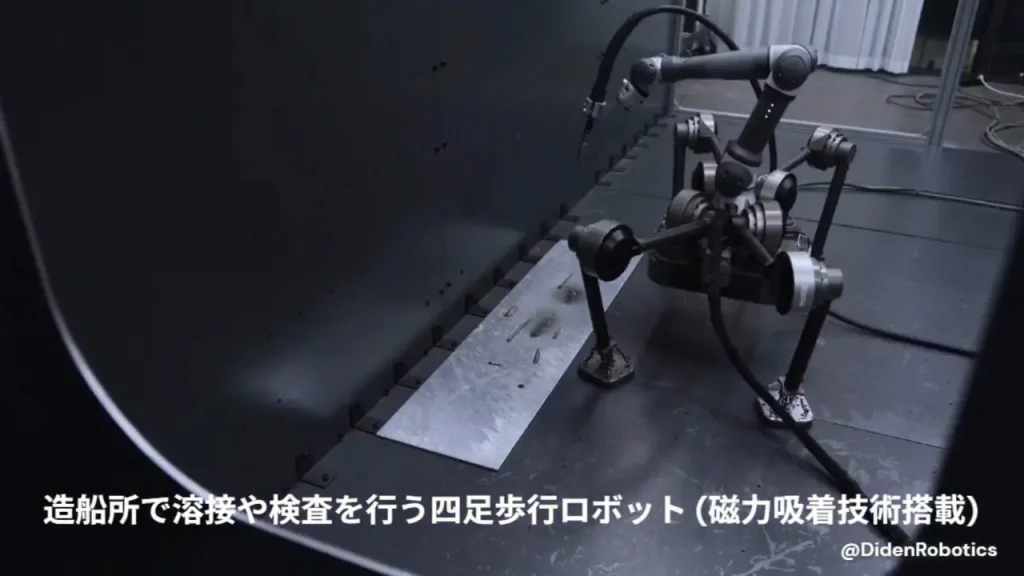
South Korean company Diden Robotics has brought its four-legged industrial robot, the Diden Spider, to the commercial market. The machine was built specifically for the shipbuilding industry: magnetic feet let it move freely across vertical bulkheads, ceilings and curved steel structures inside ships under construction. For an industry where workers regularly have to weld seams in enclosed and dangerous compartments (ballast tanks or a vessel’s double bottom, for example), adopting this kind of assistant means long-awaited automation of the most injury-prone work.
Magnetic “feet” and a 30 kg payload
The robot’s grip comes from electropermanent magnets (EPMs). Unlike conventional electromagnets, they need only a short electrical pulse to switch states. Once a “foot” locks onto metal, it holds the weight securely without drawing power continuously. As explained on Diden Robotics’ official website, this design not only saves battery charge but also ensures the heavy machine won’t come off a vertical wall if power suddenly fails.
The robot’s own compact actuators deliver a high peak torque of 387 N·m, even though each weighs less than two kilograms. The Diden Spider can carry up to 30 kg of payload while moving across a vertical surface. That margin is enough to mount robotic arms, portable welding machines or flaw detectors for checking weld quality.
『造船所で溶接や検査を行う四足歩行ロボット』
— T.Yamazaki (@ZappyZappy7) September 24, 2026
足元に電磁永久磁石を採用し、垂直な壁面や曲面状の鋼構造物上の移動が可能。https://t.co/fm0n0ukhyf#quadrupedal #robot #PhysicalAI #welding #inspection #shipyard #magnet #EPM #DidenSpider #DidenRobotics pic.twitter.com/Jz9iGWkbLG
Autonomy in the holds and work on real ships
The robot isn’t blindly steered by an operator every second. The system combines cameras, sensors and autonomous navigation algorithms trained in simulation. The Spider can plot its own route, navigate around protruding frame elements and reach the right spot to perform a task.
The Diden Spider has already outgrown the lab-concept stage and is working in real production. According to data from the InnoVEX technology expo, the technology is being deployed at shipyards run by South Korea’s so-called “big three” shipbuilders: Samsung Heavy Industries, Hanwha Ocean and HD Hyundai. The first commercial batches shipped to customers in the first quarter of 2026.
For now, the robot’s capabilities are geared toward two main tasks — welding and hull inspection. Claims have circulated online that the machine is already doing serial ship painting, but the company itself still positions the spider as a mobile welding and diagnostic platform with room to expand its functions in the future.