







Water Will Have to Be Delivered to Plants Differently on the Moon — Low Gravity Changes How Liquids Behave
 ·
03.10.2026 16:03
·
3 min read
·
03.10.2026 16:03
·
3 min read
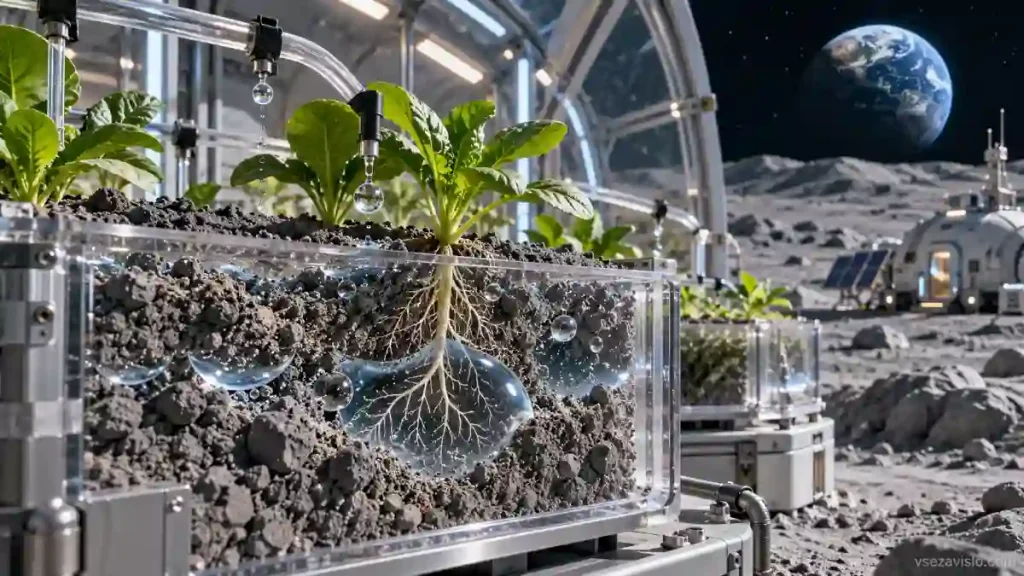
Watering plants at future lunar bases the usual Earth way may not work. An experiment by US scientists showed that under gravity close to the Moon’s, surface tension has a stronger effect on how water is distributed, so the liquid flows and wets surfaces differently. The results were published in the journal Microgravity Science and Technology.
The test was not run in a laboratory centrifuge on Earth but during the Blue Origin New Shepard 29 suborbital flight. The capsule was spun at about 11 revolutions per minute, creating centrifugal acceleration close to one-sixth of Earth’s gravity.
The experiment phase lasted about 2.3 minutes. During that time the equipment took 86 images of the liquids at an acceleration of 1.76 m/s² — roughly 8% higher than the Moon’s actual gravity.
Water, saline solution and glycerin sent on a suborbital flight
The scientists compared three liquids: plain water, a solution with 30% glycerin, and water with 0.8% salt. The camera recorded the shape of the meniscus — the curved surface of the liquid at the walls of the container — under Earth gravity and artificial lunar gravity.
The difference turned out to be noticeable. At lower acceleration, the liquid depended more on its interaction with the walls and on surface tension, and its surface became more rounded. Florida Institute of Technology notes that for future irrigation systems this means they will have to be designed specifically for lunar conditions rather than simply adapted from Earth solutions.
The glycerin solution proved especially interesting: it showed improved wetting of the surface. The authors suggest that additives with similar properties or hydrogels could in the future help distribute moisture in lunar soil.
The main problem is not just low gravity
Lunar regolith consists mostly of very fine particles and, when dry, is poorly wetted by water. Combined with low gravity, this can lead to uneven moisture distribution around the roots. Too much water in one area and too little in another are dangerous for plants, including because of a lack of oxygen in the root zone.
At the same time, the study cannot yet be treated as a ready-made guide for lunar greenhouses. The authors themselves point to the experiment’s limitations: the results were affected by the roughness of the 3D-printed containers, the properties of their walls and even small leaks. The next step should be longer tests with real or simulated lunar regolith.
Experiments like these are needed even before permanent bases appear: plants on the Moon are seen not only as a source of food but also as part of a life-support system capable of producing oxygen, purifying water and processing some of the waste.