








Moon May Have Formed Just Five Hours After Earth Collided with Theia
 ·
07.09.2026 21:13
·
2 min read
·
07.09.2026 21:13
·
2 min read
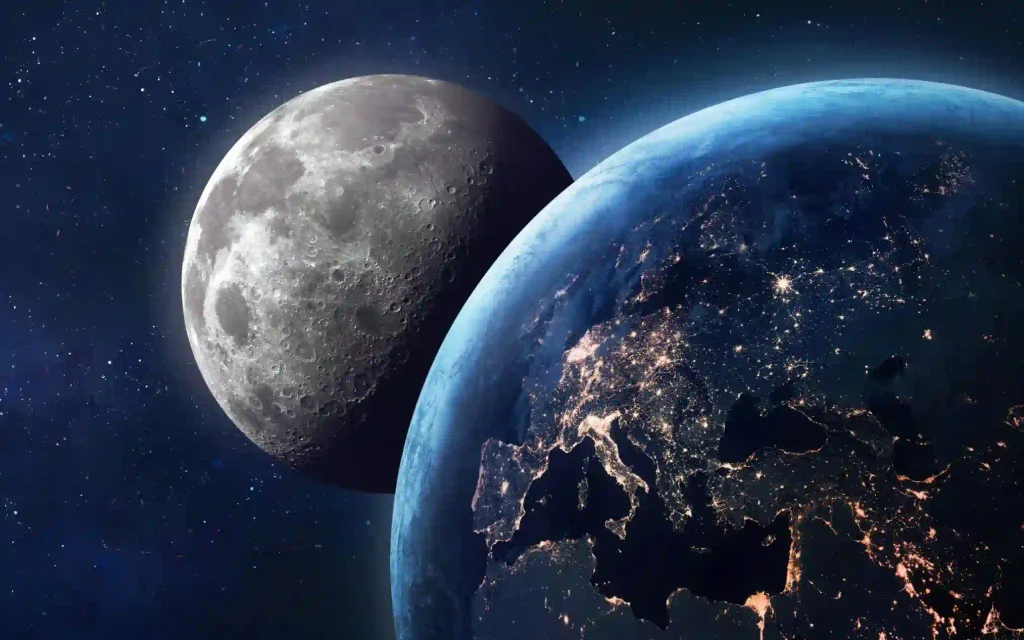
The Moon may have appeared in Earth’s orbit in just five hours following a cosmic collision, rather than over centuries of accretion from a dust and gas cloud. This is the conclusion reached by astrophysicists at the Southwest Research Institute (SwRI) and the University of Arizona, who published the results of a new large-scale simulation in The Astrophysical Journal Letters.
Solid Rock Instead of Liquid Droplets
According to the widely accepted giant-impact hypothesis, about 4.5 billion years ago, a young Earth collided with Mars-sized wandering protoplanet Theia. However, most classical calculations treated both bodies simplistically as fluid hydrodynamic objects, as physicists considered the strength of solid rocks negligible under the colossal energy of a planetary impact.
The authors of the new study are the first to incorporate temperature-dependent mineral strength into their calculations. This parameter fundamentally alters the impact dynamics:
- Hot, molten mantle material quickly loses structural integrity, scattering into a broad debris disk around Earth;
- Cooler silicate rocks retain enough mechanical strength to resist complete vaporization.
As noted in a Southwest Research Institute press release, simulations showed that under certain temperature conditions, Theia did not turn into dust. Its iron core sank into Earth’s interior, while a single large chunk of mantle was ejected into a stable orbit, forming a nearly complete proto-Moon in just five hours.
Isotope Dilemma and the Age of the Catastrophe
The rapid formation scenario aligns with data presented by NASA astrophysicists in 2022. The new study proves that the instantaneous birth of the satellite is physically possible without necessarily passing through a prolonged red-hot ring phase.
However, the model does not yet resolve a key paradox of lunar geology: lunar samples show an almost exact isotopic oxygen match with Earth rocks, whereas ejecting a solid piece should have caused the satellite to inherit Theia’s chemical composition.
The study’s primary value lies elsewhere: how collision outcomes depend on protoplanet temperature will help narrow down the date of the cosmic collision. Because young planets cooled continuously after accretion, thermodynamic constraints will allow geologists to narrow the time window for the formation of the Earth-Moon system.