








OpenAI Claims Solution to Navier–Stokes Millennium Prize Problem, Prompting Authorship Dispute
 ·
08.09.2026 21:27
·
3 min read
·
08.09.2026 21:27
·
3 min read

OpenAI has announced a fundamental scientific breakthrough, claiming that an unreleased experimental model has solved one of the seven Millennium Prize Problems: the existence and smoothness of solutions to the three-dimensional Navier–Stokes equations. Finding the mathematical proof required 88 hours of computation and the coordinated work of a swarm of 10,000 parallel AI agents. However, the Clay Mathematics Institute still considers the problem unsolved, and the academic community is only beginning a lengthy review of the calculations.
What the Problem Means and What the Neural Network Proved
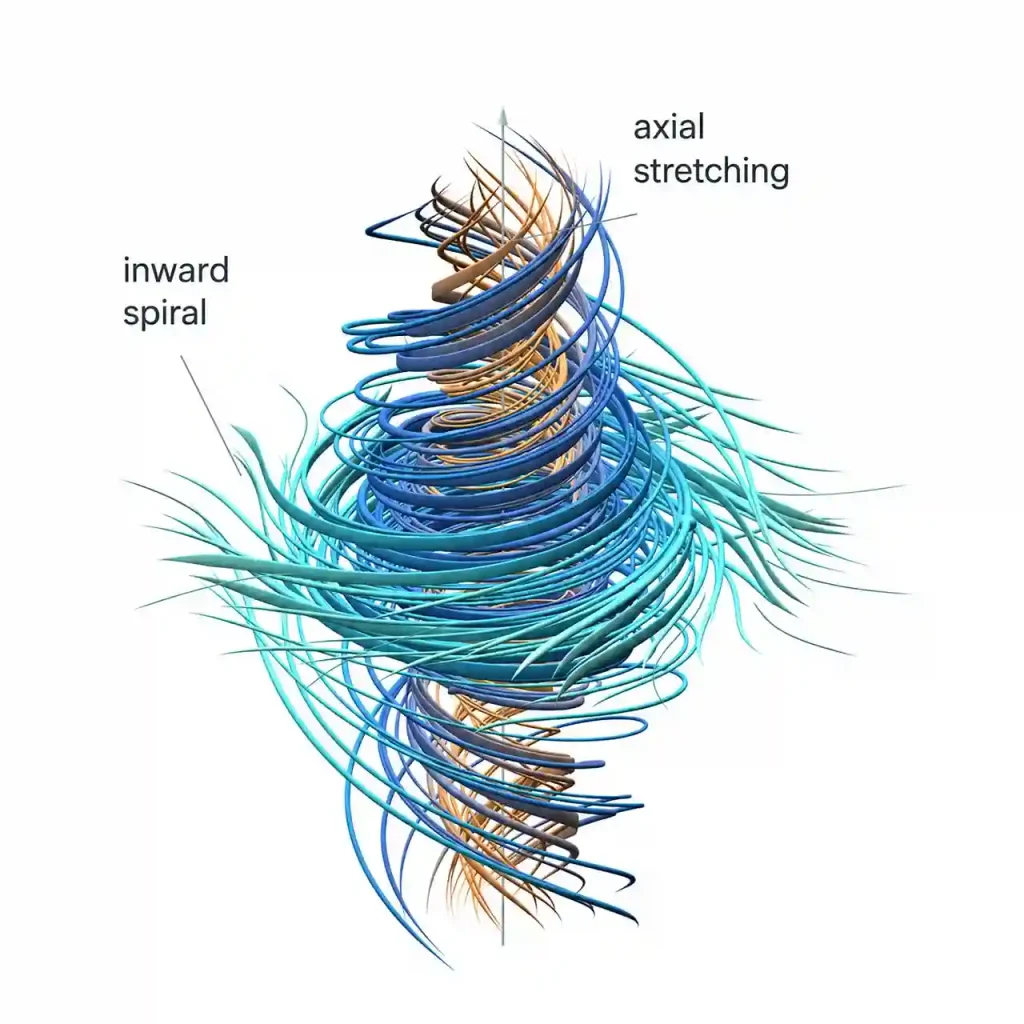
The Navier–Stokes equations describe the physics of fluid and gas dynamics, from ocean currents to turbulence around an airplane wing. While numerical approximations have been used in applied engineering for decades, a fundamental mathematical question has remained open for nearly two centuries: do solutions to the three-dimensional equations remain smooth indefinitely, or do they inevitably form a singularity (blow-up) under certain conditions, causing velocity or pressure to shoot to infinity?
As reported by The Wall Street Journal, OpenAI’s algorithm constructed a mathematical counterexample, proving that a finite-time singularity is fundamentally possible. The proof spans roughly 165 pages, and all intermediate steps were formalized and verified in the Lean 4 interactive theorem prover environment.
The computations were performed not by the production GPT-6 Astra, but by an even more complex internal system. On an internal benchmark of advanced math competition problems, Astra solved roughly 10% of the tasks, whereas the new architecture solved about 50%. During the 88-hour push, a cluster of ten thousand agents tested different mathematical branches in parallel, cross-checking each other’s reasoning.
Why No One Has Received the $1M Prize Yet
Despite headline-grabbing news, the Navier–Stokes problem officially remains unsolved.
According to the rules of the Clay Mathematics Institute, automated verification in Lean or a preprint server posting is not enough:
- The proof must undergo full peer review and be published in a recognized mathematics journal;
- Publication triggers a mandatory two-year waiting period during which mathematicians worldwide look for hidden logical gaps;
- Only after widespread acceptance by the international community does the institute’s advisory board initiate the official recognition process.
The Poincaré conjecture, proved by Grigori Perelman, remains the only solved problem among the seven. Meanwhile, according to Axios, OpenAI itself does not intend to claim the $1 million prize awarded for the solution.
Authorship Dispute and Data Leak Suspicions
The announcement is accompanied by a conflict over scientific priority. New York University mathematician Tristan Buckmaster and Anthropic researcher Levent Alpoge were independently working on a similar approach.
In an official statement, Buckmaster claims OpenAI learned of their research shortly before making its announcement. He also raised the question of whether researchers’ private work sessions in Codex tools might have served as training data for OpenAI’s agents. There is no direct evidence of this, and OpenAI representatives flatly rejected any allegations of using third-party drafts.
Solving a complex math problem does not in itself mean artificial general intelligence (AGI) has been achieved. However, if the 165-page paper is verified by independent researchers, it will mark the first proof in history that neural networks can make fundamental research-level discoveries, rather than merely organizing existing knowledge.