








Google Opens Public SynthID Detector: Tool Spots Invisible AI Watermarks From Google, OpenAI and Nvidia
 ·
09.10.2026 18:50
·
3 min read
·
09.10.2026 18:50
·
3 min read
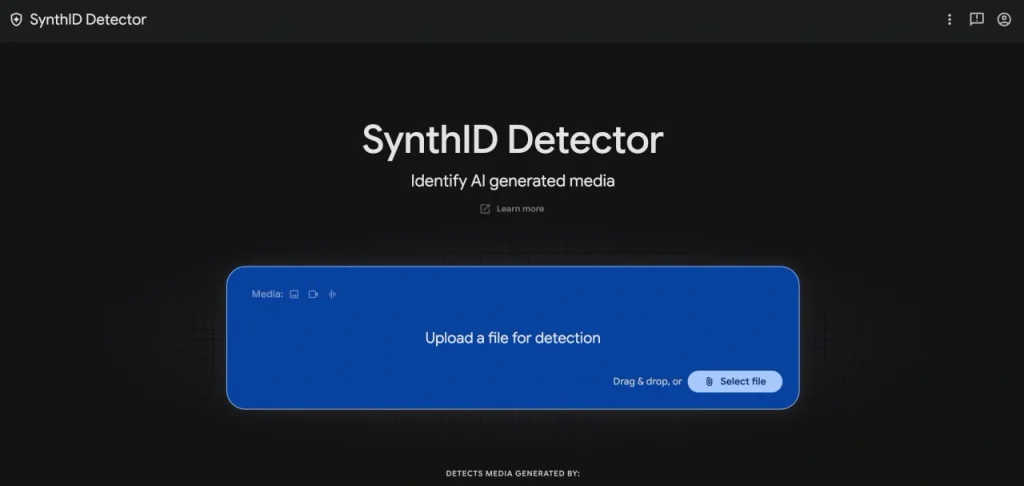
Google has made its tool for detecting AI-generated media publicly available worldwide. Anyone can now visit the official SynthID website, upload an image, video or audio file for free, and check whether a generative neural network left a digital signature in it. The service runs directly in the browser with no registration required.
SynthID was created by the Google DeepMind lab back in 2023. Unlike the familiar semi-transparent logos in the corner of the screen, the system embeds a steganographic watermark invisible to the human eye into the source code of a media file. According to Google’s blog, more than 180 billion images and videos have already been marked with the technology worldwide, along with a vast array of audio recordings totaling about 240,000 years in length.
An Industry Standard Instead of a Closed Ecosystem
The key move in the new release is dropping corporate isolation. The detector is no longer tied exclusively to the company’s own Gemini or Imagen models. The algorithm now scans and successfully recognizes hidden meta-tags embedded by third-party generative services from OpenAI, Nvidia and South Korea’s Kakao. In upcoming updates, the developers promise to add support for Apple’s ecosystem.
The digital fingerprint is designed to survive typical manipulation on social networks and in graphics editors, according to DeepMind’s technical description:
- in photos, the mark survives cropping, color filters, contrast changes, resolution reduction and aggressive JPEG compression;
- in video, the marks are woven directly into the structure of individual frames;
- in audio tracks, the code survives conversion to MP3, playback speed changes and added background noise.
Why It’s Not a Universal Fake Detector
Potential users should understand the technical limits of the service. SynthID doesn’t do “detective work” on finger anatomy or unnatural glints in pupils to guess an image’s origin from indirect clues. The detector does exactly one job: it looks for a specific cryptographic signature of the SynthID standard.
That leads to an important limitation: if the system reports that no watermark was found, it doesn’t guarantee that you’re looking at real footage. The image or deepfake could have been generated by models from Midjourney, Stable Diffusion or black open-source networks that don’t embed metadata voluntarily.
Still, Google emphasizes that searching for a hardware digital mark produces far fewer false positives than traditional heuristic neural-network detectors, which regularly accuse real artists and photographers of using AI.