







Google Develops AX, an Open System for Managing Huge Fleets of AI Agents
 ·
22.09.2026 07:01
·
3 min read
·
22.09.2026 07:01
·
3 min read
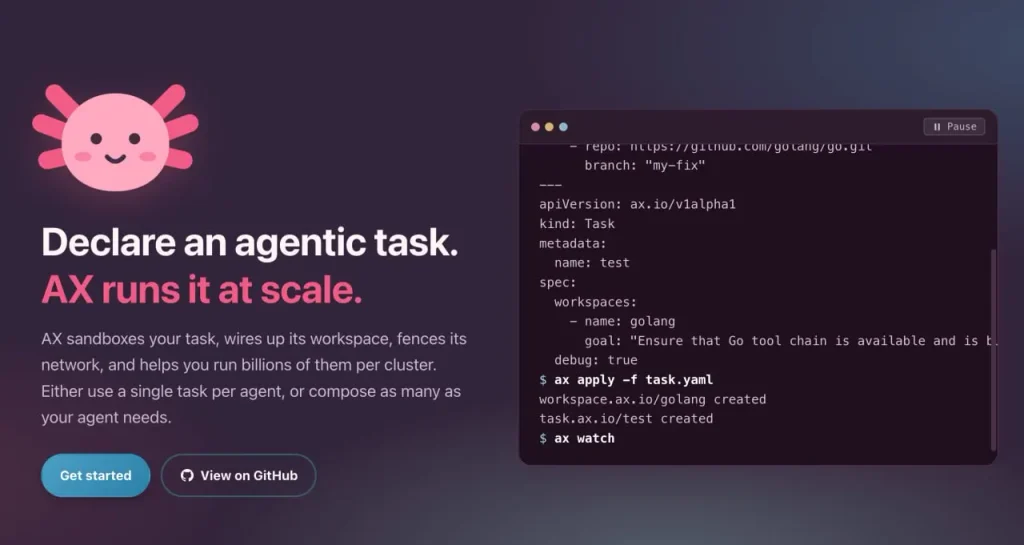
Google has open-sourced AX (Agent Executor), an infrastructure for launching and managing large numbers of autonomous AI agents. The project was first unveiled in May 2026 and is still in its early stages, though it continues to be actively developed.
AX does not create agents or replace language models. Its job is to provide an environment where agent processes can be run in isolation, equipped with tools and working files, restricted in their network access, and connected to models centrally.
The AX architecture relies on four main objects: Task, Workspace, Gateway and Model. Task describes an individual agent job, Workspace is its working environment, Gateway manages network access, and Model handles the connection to an AI model.
Agents can be suspended without losing state
Each task runs in its own sandbox with set CPU and RAM limits. Git repositories, MCP servers, skill sets and other resources can be connected to the working environment in advance.
Gateway lets you restrict the list of external hosts an agent is allowed to reach. That matters especially for large systems where hundreds or thousands of autonomous processes run at once and none of them can be given unrestricted network access.
AX also supports suspend and resume commands. An agent task can be stopped with its state preserved, freeing up compute resources, and then picked up again from the same point. Google sees this approach as a way to avoid keeping infrastructure busy while an agent waits for a response from a model, an external tool or a human.
At the core of the system is Agent Substrate, a specialized layer on top of Kubernetes for agent workloads.
The developers say its architecture is designed to scale to billions of agent tasks in a single cluster, to restore suspended processes quickly and to use compute resources more densely. However, for now this is the project’s stated architectural goal rather than an independently confirmed load-testing result.
AX targets developers, not no-code users
Some AX features let you describe the required working environment in natural language, but the platform itself is not a no-code service.
Getting started quickly requires a Kubernetes cluster, Go, ko, a container registry and a running Agent Substrate API. That makes AX primarily a fit for platform developers, DevOps engineers and teams building their own infrastructure for autonomous agents.
The project is distributed under the Apache 2.0 license. Google separately warns that AX is still at an early stage: the API, architecture and individual components may change significantly before a stable version arrives.
As a result, AX is interesting not as yet another ready-made AI assistant but as an attempt to solve a more fundamental problem: how to manage large numbers of long-lived agents as systematically as containers and cloud services are managed today.