









Google launches Playground, letting users create games with text prompts right in the browser
 ·
07.10.2026 20:07
·
3 min read
·
07.10.2026 20:07
·
3 min read
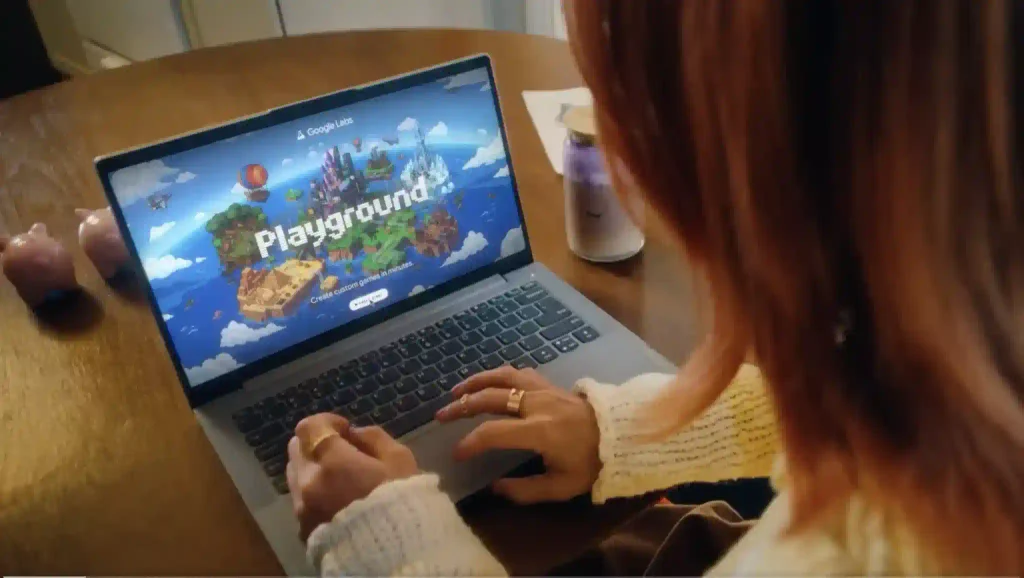
Google has launched Playground, an experimental platform where users can create full-fledged game projects using ordinary text commands without any manual coding. At the same time, the company announced a partnership with Unity: the next step will be Unity Spark, designed for more complex games with full 3D graphics.
In Playground, work begins with describing an idea. Users can ask to create characters, environments and rules, immediately launch the resulting game, and then continue editing it in a dialogue with AI.
For example, commands can change the physics, rewrite the rules, replace characters or completely rebuild the game world. Google emphasizes that this is not necessarily a “one prompt — finished game” scheme: the project can be tested and refined gradually.
Created games can be sent to others right away
Playground runs in the browser, and created projects launch on both computers and smartphones. A game can be kept private, sent to friends via a link, or published in a shared gallery.
Some genres support multiplayer and leaderboards. Through a Google Play Games profile, users can also follow creators and rate their projects.
Every publicly published game goes through automatic checks for compliance with platform rules, and users have access to a reporting system.
Currently, Google has opened Playground only to users over 18 in the US. The number of available generations depends on the Google One tier. The company calls the service an early experiment and has not yet announced launch dates for other countries.
🚨NEW EXPERIMENT 🚨 Playground is an experimental gaming platform that lets you create your own games with zero coding experience. If you can think it, you can play it. Go to https://t.co/fRUukpuoqM to learn more! Available to users 18+ in the US. https://t.co/p0X8JR7JMn
— Google Labs (@GoogleLabs) October 7, 2026
Unity Spark is designed for more complex projects
At the same time, Google and Unity announced a strategic partnership. Later in 2026, they plan to expand the Playground concept with Unity Spark.
Spark will keep natural-language interaction but add full Unity Runtime capabilities, more complex game mechanics and high-quality 3D graphics. The project is thus meant to be an intermediate option between a simple browser game generator and traditional development in a game engine.
Unity pays special attention to content. Spark will be directly connected to the Unity Asset Store, so instead of generating all models from scratch, creators will be able to use ready-made assets created by artists and developers.
Unity CEO Matt Bromberg emphasizes that the company does not want to turn Spark into a service for creating a copy of an existing game with a single prompt. The idea is to give users a foundation and tools for consistent development, testing and refinement of their own project.
The Unity Spark editor itself is not yet publicly available. A waitlist is open on the official page, and a closed beta is set to begin soon. Several demo games created with Spark can already be launched in the browser.
Playground and Spark show where another area of generative AI is heading: instead of learning a programming language and a complex editor, the first step in game development could be a plain description of what a person wants to create.