










Enthusiast Mounts Tower CPU Cooler on GTX 1080 Ti, Drops Temps to 32°C
 ·
24.08.2026 19:21
·
2 min read
·
24.08.2026 19:21
·
2 min read
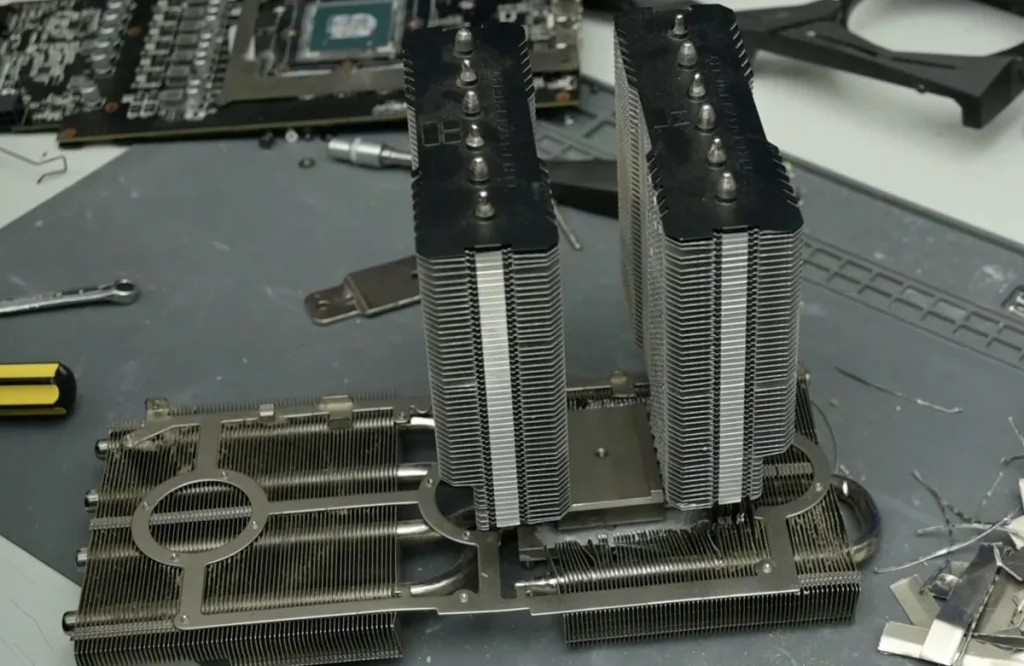
The creator of YouTube channel TrashBench conducted an unusual hardware experiment by mounting a massive tower CPU cooler onto GeForce graphics cards. As reported by Tom’s Hardware, modifying a flagship GeForce GTX 1080 Ti reduced GPU temperatures under load down to 32°C while cutting power draw by 30W.
The experiment began by testing lower-end Pascal generation models and culminated in modifying the top-tier card.
Angle Grinder, Drill, and Initial Tests on the GTX 1060 and GTX 1070
Differences in mounting holes make it impossible to attach a CPU cooler to a graphics card directly. The modder trimmed part of the aluminum fins from a stock ASUS Strix heatsink using an angle grinder, drilled holes into the cold plate, and attached a dual-tower cooler with two 120mm fans onto it.
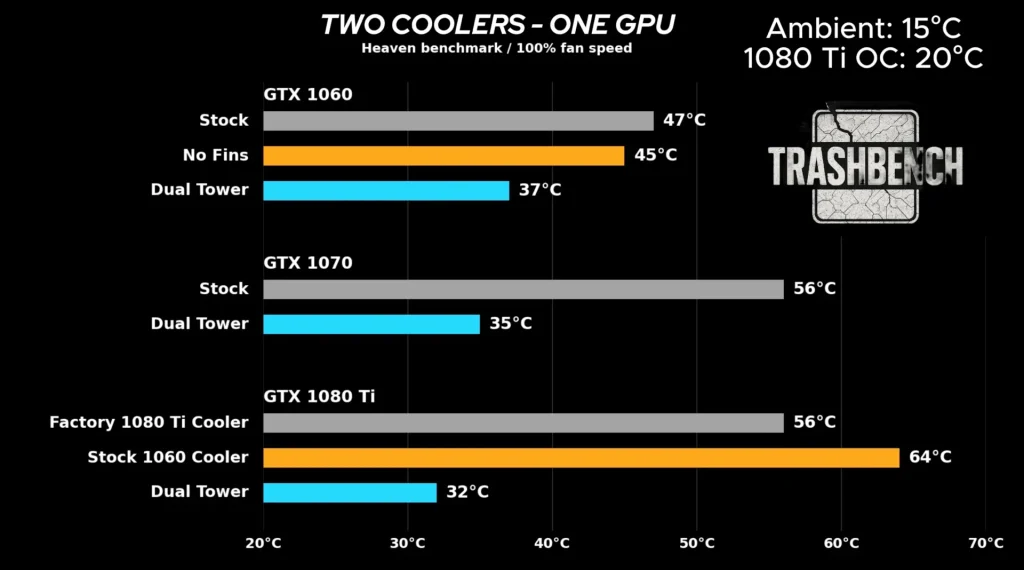
According to VideoCardz, operating chip temperatures on the GTX 1060 dropped from 47°C to 37°C, while overclocking boosted gaming performance by 9%.
On the GTX 1070, benchmark temperatures fell from 56°C to 35°C (a 21°C drop), allowing the GPU to be overclocked to 2177 MHz and yielding an extra 7% FPS while reducing power draw by 15W.
Extreme Results on the GTX 1080 Ti
The primary test subject was the 250W GTX 1080 Ti. With the massive heatsink attached, chip temperatures under full load dropped to 32°C, while hotspot readings registered 42°C compared to 72°C on the control setup (a 30°C reduction).
Lower silicon temperatures improved semiconductor conductivity: at a fixed clock speed, the modified graphics card drew 30W less power (roughly 12% energy savings) and overclocked to 2152 MHz.
Limitations of the DIY Mod
Testing took place under favorable open-test-bench conditions with an ambient air temperature of 15°C and fans running at maximum speed.
Due to the immense weight and size of the CPU tower, the setup is unsuitable for standard PC cases without specialized support brackets. However, the experiment clearly demonstrated the strong overclocking potential of Pascal architecture chips once thermal limits are removed.