








NVIDIA Open-Sources SoL-Pi, Cutting AI Agent Token Use by Up to 49%
 ·
20.09.2026 23:42
·
4 min read
·
20.09.2026 23:42
·
4 min read
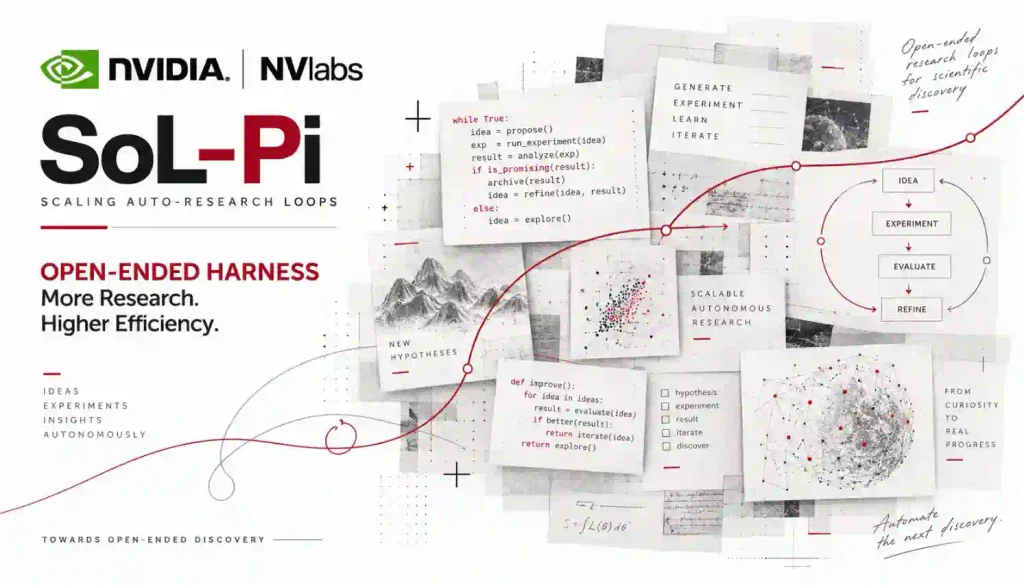
NVIDIA has open-sourced SoL-Pi, an extension for the Pi framework designed to cut costs during long-running AI agent sessions. The source code is published on GitHub under the MIT license.
SoL-Pi is not a separate language model. It is a layer on top of the Pi agent environment that tries to reduce the number of repeat calls to the model, the amount of context that gets passed again, and unnecessary reads of large tool outputs.
The project grew out of NVIDIA’s automated research loops. AI agents proposed 152 optimization directions, and after testing, four mechanisms made it into the final system.
One combines sequential actions — such as editing a file and then checking it — into a single call. Another replaces resending large tool outputs with compact references that can precisely restore the needed fragment. A third compresses completed parts of the context, and a fourth hands off reading long logs to a cheaper agent, verifying the lines it cites against the original.
NVIDIA's SoL-Pi, now on Hugging Face paper pages
— DailyPapers (@HuggingPapers) September 18, 2026
A token-efficient agent harness built by recursively scaling auto-research loops. It cuts token traffic by 44.7-49.0% and API cost by about one third while preserving performance. pic.twitter.com/EMhnRRqkSW
Up to 49% fewer tokens, with a small drop in results
NVIDIA saw the biggest effect on EdgeBench, a set of 51 long-running agent tasks, each of which can take several hours to complete.
In a test with GPT-5.6 Sol, standard Pi used about 2.154 billion tokens, while SoL-Pi used roughly 1.099 billion. That works out to a reduction of about 49%.
The estimated cost of running the model fell from $1339 to $894, or about one third.
The savings were not entirely free in terms of quality, though. SoL-Pi averaged 42.0 points versus 44.8 for standard Pi — about 94% of the original environment’s result.
On the project page, NVIDIA states this trade-off outright: with GPT-5.6 Sol and Claude Opus 5, the system retained about 94% of Pi’s average score while cutting token use by 45–49%.
So framing it as “the same quality with half the tokens” would be too strong. It is more a case of a significant cost reduction with a relatively small loss in results on specific tests.
The optimizations can be enabled individually
SoL-Pi installs on top of the standard version of Pi and does not require changes to its source code. All four mechanisms are off by default and are enabled separately through configuration.
That lets you, for example, use only the local optimizations without turning on the mechanism that can send long diagnostic logs to an additional model.
NVIDIA also tested SoL-Pi with Claude Opus 5. In that case, token use fell by about 44.7% compared with Pi, and cost dropped by roughly one third.
The authors also compared the system with native agent environments such as Codex and Claude Code, where savings were even higher in some tests. However, the results apply to specific models, settings and long-running EdgeBench tasks, so the same percentages cannot be carried over to any agent scenario.
SoL-Pi is interesting above all as an example of how AI agent efficiency can be improved not only through new models. A significant share of the cost comes from how the agent’s work is organized — resending context, long logs and extra model steps that can sometimes be eliminated at the software environment level.