








Uncensored Build of Ornith-1.5-9B Enables Fully Local, Cloud-Free Execution
 ·
12.09.2026 14:13
·
2 min read
·
12.09.2026 14:13
·
2 min read

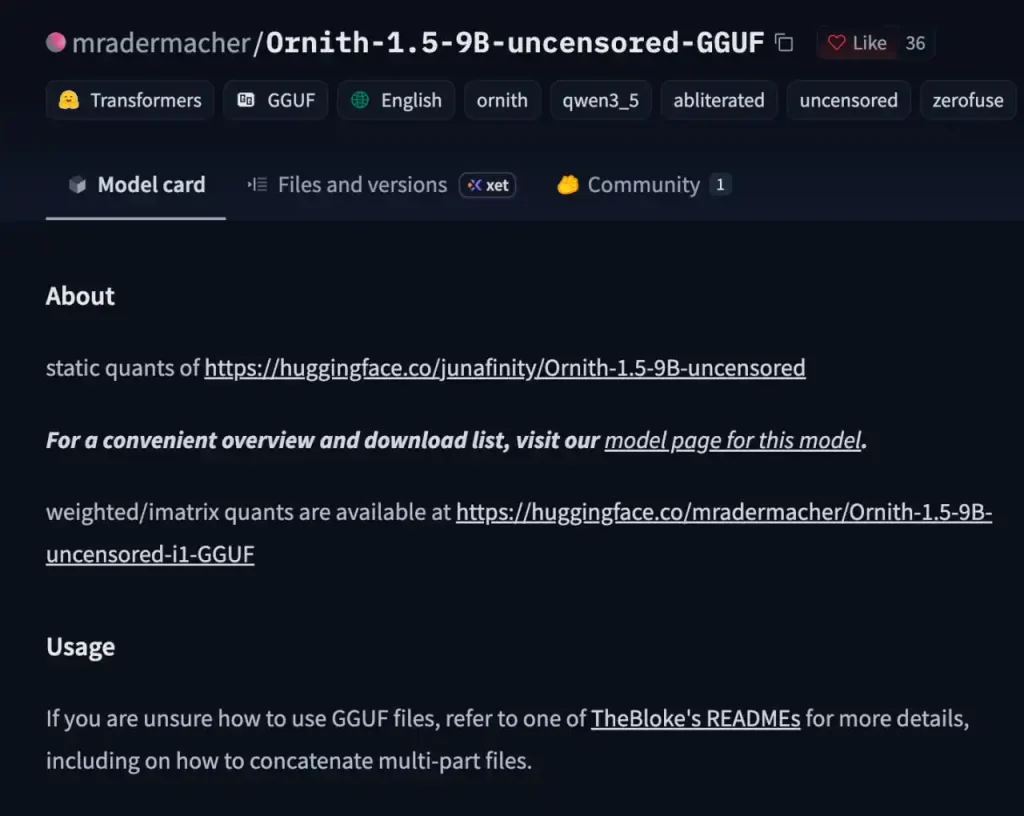
An unofficial modification removing system guardrails has been released for the compact multimodal model Ornith-1.5-9B. Dubbed Ornith-1.5-9B-uncensored, the build eliminates built-in refusals when handling sensitive prompts and has been converted into GGUF and MLX formats for fully standalone local execution on consumer PCs via llama.cpp.
The Abliteration Technique and Retaining Vision Capabilities
The base Ornith-1.5-9B model was developed by Ornith AI on top of the Qwen3.5 architecture. It features a native 262,144-token (256k) context window, image recognition capabilities, and strong coding performance, scoring 70.6% resolved tasks on the SWE-bench Verified benchmark.
The uncensored version was created by independent developer junafinity using the abliteration technique. Using the ZeroFuse utility, the author removed directions from the weight matrix that trigger safety guardrails when processing controversial instructions. In internal stress tests using 64 malicious prompts, the base model refused 9 requests, while the Ornith-1.5-9B-uncensored build completed every task without refusals.
The model retains vision support: in mradermacher’s GGUF quant repository, the visual projector is distributed as a separate ~1GB file. The language model itself ranges from 3.9GB in the ultra-light Q2_K profile to 5.7GB in the recommended Q4_K_M quantization (9.6GB in 8-bit Q8_0).
Actual Memory Requirements and the Smartphone Myth
Across tech forums, the release sparked viral claims that the model can easily run on any phone with 8GB of RAM. In practice, file size in gigabytes does not reflect actual memory consumption.
Loading the 9-billion-parameter model alongside its vision adapter and operational buffers requires between 8GB and 12GB of available VRAM. Attempting to feed a long 256k-token context will cause the KV cache to balloon, demanding tens of additional gigabytes of RAM—a footprint out of reach for mobile devices.
The project was designed for research purposes, including red teaming and coding workflows free of false-positive safety triggers. While the quantized files make the model an excellent local PC tool, stripping built-in filters places full responsibility for the safety of its outputs entirely on the user.