









MOTHRA Telescope Captures Decay of Dead Star: Helix Nebula Shows Sun’s Future
 ·
17.08.2026 21:37
·
2 min read
·
17.08.2026 21:37
·
2 min read
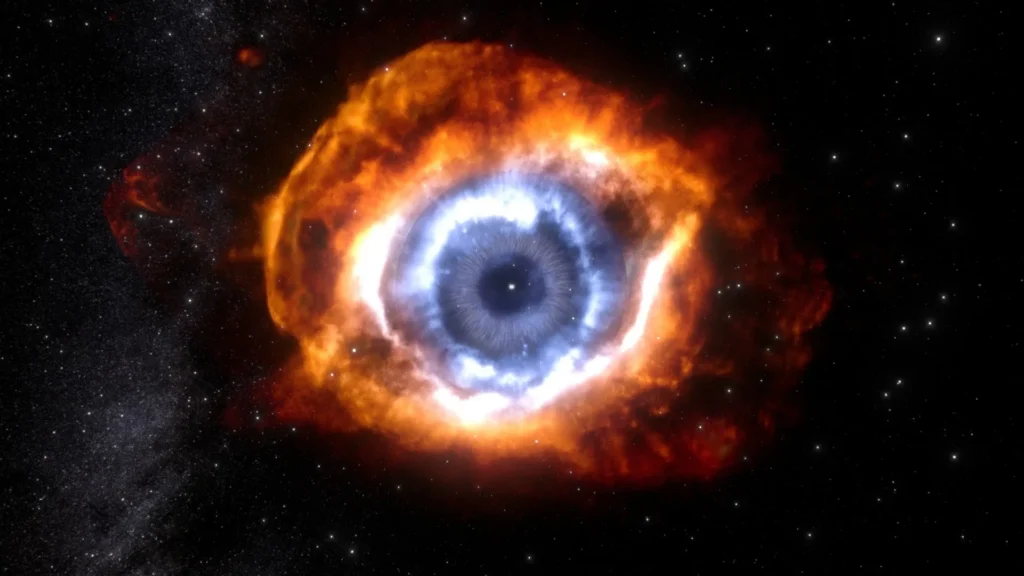
Astrophysicists have traced in detail for the first time how material from the shed envelopes of a dying star breaks down and disperses into the interstellar medium. Observations of the Helix Nebula clearly demonstrate the process of cosmic recycling that our Sun is expected to undergo in roughly 5 billion years.
The Helix Nebula lies approximately 650 light-years from Earth in the constellation Aquarius. At its center rests a white dwarf—the cooling core of a star that shed its outer layers during the red giant phase.
During the calibration of the MOTHRA optical array currently under construction in Chile, scientists discovered 22 arc-shaped shock waves in the outer region of the nebula. These structures form in areas where dense clumps of stellar material collide at high speed with interstellar gas. As they move away from the central white dwarf, the arcs gradually lose their shape and fragment.
10,000 Years to Dissolve and Recycle Matter
According to a study published in the journal Nature, an individual fragment of ejected stellar gas maintains its structure for about 10,000 years after colliding with the surrounding medium, before completely breaking apart and mixing with galactic matter.
As researchers at Northwestern University note, the discovery was made accidentally thanks to MOTHRA’s unique optical design: once operational, the facility will combine 1,140 telephoto lenses to search for faint gas structures across vast areas of the sky.
The observations support the cosmic recycling model: elements ejected by dead stars eventually become part of new gas and dust clouds from which future generations of star systems form. As Space.com highlights, the Sun faces a similar fate in 5 billion years—after its red giant phase, it will collapse into a white dwarf while its outer layers disperse across the Milky Way.