









Scientists Propose Building a Radio Telescope on the Far Side of the Moon Before Satellites Drown It Out
 ·
19.08.2026 19:07
·
3 min read
·
19.08.2026 19:07
·
3 min read
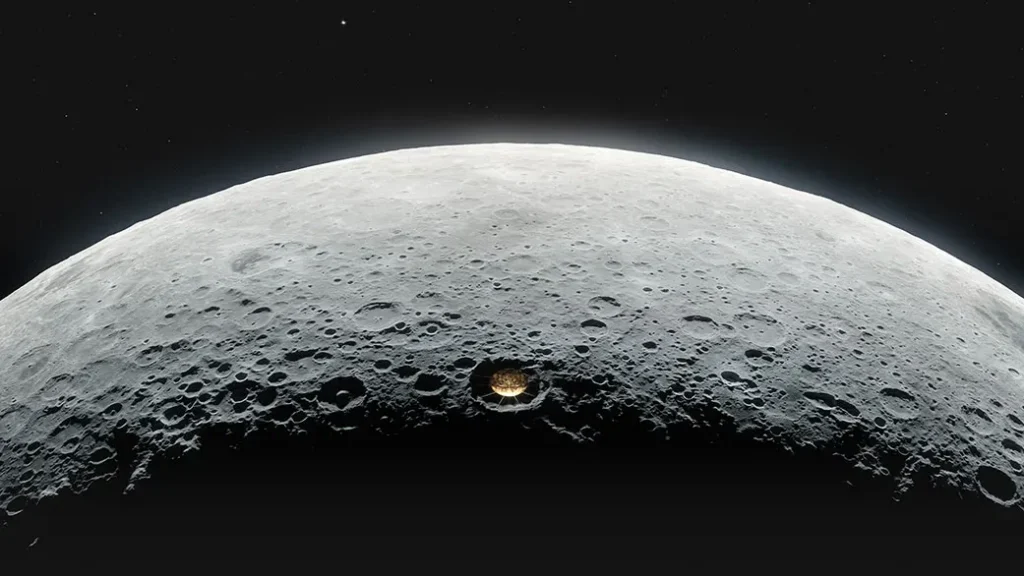
An international team of astrophysicists has designed a specialized lunar radio telescope called LFT3 to search for extraterrestrial technosignatures and study distant worlds. According to Universe Today, the observatory, which will cost about $150 million, is slated to be delivered to the far side of the Moon before 2030, while the natural “radio quiet zone” is still free of interference from orbital satellite constellations.
The far side of the Moon is shielded from Earth’s radio noise, and the lack of an ionosphere opens up the low-frequency range below 30 MHz, which is completely blocked by Earth’s atmosphere.
Threat of Radio Noise from Satellites by 2030
The authors cite the active development of cislunar space as the main reason for the rush. According to a scientific paper on arXiv, starting in mid-2028, at least one communications satellite will be permanently stationed above the far side of the Moon.
By 2030, the researchers estimate, the density of radio interference in lunar orbit will approach that of Earth in the early 1960s. The arrival of navigation and communications constellations will permanently destroy the region’s unique radio environment, so scientists are eager to deploy their equipment in the last years of natural isolation.
Searching for Signals from Civilizations and Magnetic Fields of Exoplanets
The LFT3 program, supported by the Breakthrough Listen project, will cover a frequency range from 0.1 to 2700 MHz. The array’s sensitivity will allow it to detect potential artificial signals from civilizations comparable in power to the famous “Wow!” signal of 1977.
In addition to searching for technosignatures, the telescope will detect radio emission from exoplanets’ magnetic fields — a key marker of a thick atmosphere and potential habitability of distant worlds. The instrument will also monitor fast radio bursts (FRBs), pulsars, solar storms, and radio signals from lightning in the atmospheres of giant planets.
Autonomous AI and Cooperation with LuSEE-Night
The ~100 kg array is planned to be mounted on a three-meter landing platform, equipped with 48 antenna elements and 20 TB of storage. Due to the lack of a direct link to Earth, data transmission via a relay satellite is limited to a modest 100 GB per month: an onboard computer will perform initial analysis of the radio spectrum and filter out noise right on the lunar surface.
A similar precursor project is already in the works: the smaller radio module LuSEE-Night will be sent to the far side of the Moon as part of the Blue Ghost 2 mission. The LFT3 team hopes to land nearby to calibrate their instruments using joint measurements before the end of the decade.