








Apple Unveils iPhone Duo, Its First Foldable With Two Displays, Apple Pencil Support, and Touch ID
 ·
09.09.2026 21:22
·
5 min read
·
09.09.2026 21:22
·
5 min read
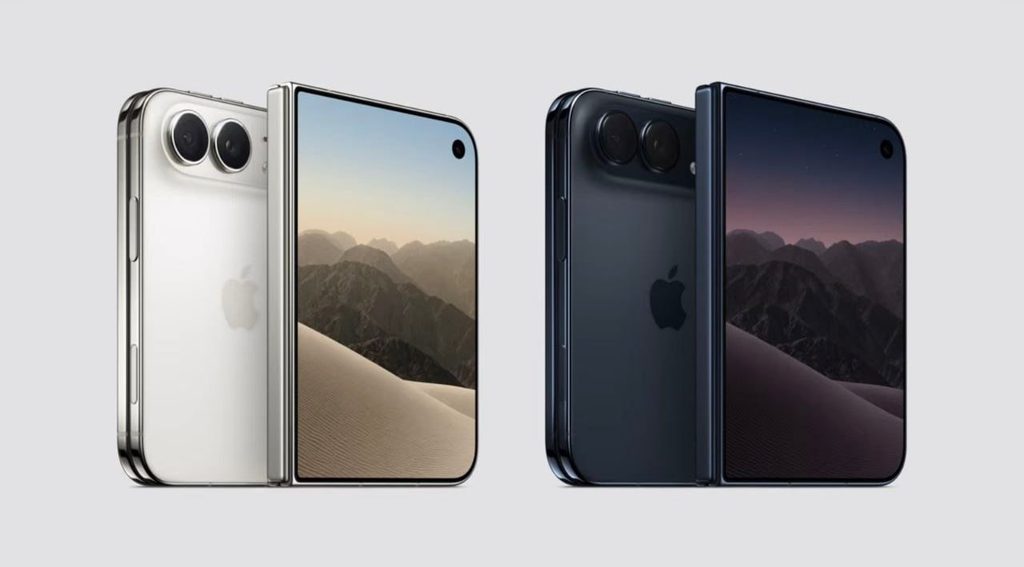
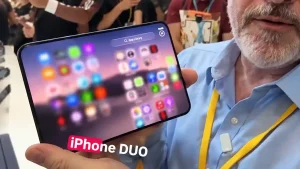
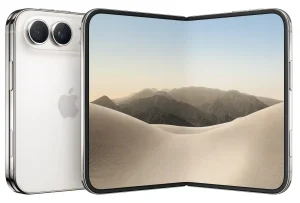
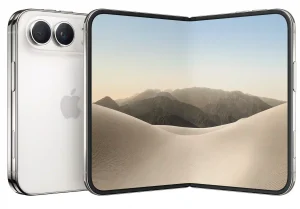
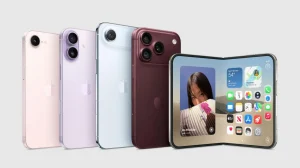
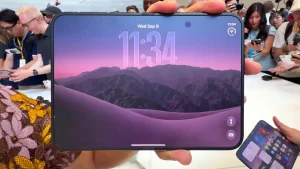
Apple has made a historic announcement, officially unveiling the iPhone Duo — the first foldable smartphone in the brand’s history. The device features a book-style design: a compact display on the outside for everyday calls and messaging, and when opened, users get a flexible 7.6-inch tablet-sized screen.
Apple’s entry into this segment comes notably later than its direct competitors. The first Samsung Galaxy Fold debuted back in 2019, followed by foldable flagships from Huawei, Honor, Google, and Oppo. According to market reports, foldable smartphones accounted for only about 1.6% of global sales in 2025. With the iPhone Duo, Cupertino hopes to overcome the category’s niche status and make foldable screens a mainstream consumer standard.
Passport-Sized When Folded, Giant Screen, and Titanium With Ceramics
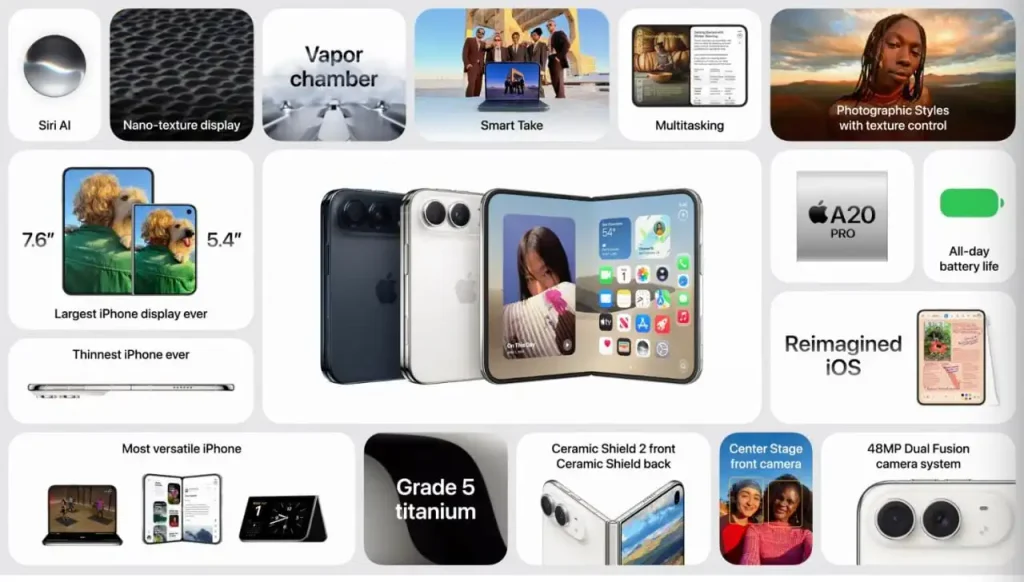
When folded, the iPhone Duo’s body resembles a passport in size and proportions, featuring a 5.4-inch OLED display on the outside. The main workspace opens up inside: the 7.6-inch flexible panel is the largest screen ever on an Apple smartphone.
According to The Verge, the inner display’s usable area is 50% larger than the iPhone 18 Pro Max’s screen and 80% bigger than the standard iPhone 18 Pro’s. Both displays share the same aspect ratio, ensuring seamless continuity when moving apps from the outer screen to the inner one without distorting the interface scale.
The new device’s chassis is made from a titanium alloy reinforced with composite ceramic fibers (Apple claims it’s three times stronger than Grade 5 titanium). The outer display is covered with Ceramic Shield 2 glass, while the back panel is protected by a Ceramic Shield coating. Despite the complex moving hinge, the smartphone has full IP68 water and dust resistance.
At launch, the device comes in two understated colors: pearly white Star White and dark blue Night Sky.
Dropping Face ID and Bringing Back Side-Mounted Touch ID
A radical design decision is the complete removal of Face ID’s depth-scanning sensors and the Dynamic Island. Engineers made this move deliberately to minimize the thickness of the halves and free up internal space for the hinges and battery.
Instead of Face ID, the flagship features a Touch ID fingerprint scanner integrated directly into the side power button. Apple has used this mechanism successfully for years in its iPad Air and iPad mini tablets. This is Apple’s first flagship smartphone with a fingerprint scanner since the transition to Face ID with the iPhone X in 2017. The front camera for selfies and video calls remains on the outer display as a neat punch-hole cutout.
Apple Pencil Support and iPad-Level Multitasking
The iPhone Duo is the first smartphone in Apple’s history to offer official compatibility with the Apple Pencil. The inner screen’s massive diagonal turns the device into a compact digital notepad: the stylus recognizes pressure and tilt, allowing users to take handwritten notes, sketch, sign documents, and retouch photos.
The smartphone’s software has been adapted for a multi-window mode in the style of iPadOS. Users can run two full-size apps side by side via Split View, drag and drop text and images between them, or float auxiliary windows over the main content. For example, you could be on a video conference on one half of the screen while consulting a presentation or editing a spreadsheet on the other.
A20 Pro Chipset, Apple C2 Modem, and a Camera Compromise
Performance is handled by the top-tier 2nm Apple A20 Pro processor, the same chip found in the iPhone 18 Pro. It’s optimized for demanding on-device Apple Intelligence neural network algorithms and generative graphics processing.
Cellular connectivity is provided by Apple’s second-generation C2 5G modem. The main technical compromise is the rear camera setup: due to the dense internal layout of the hinge and dual batteries, only two 48-megapixel modules (main and ultrawide) are on the back, with no periscope telephoto lens for optical zoom.
Magnetic Hinge and Minimal Crease
The durability of the foldable screen and opening mechanism has long been the main barrier to releasing a foldable iPhone. The Duo debuts a patented hinge system based on magnetic guides that evenly distributes mechanical tension across the entire fold area, minimizing the visibility of the central crease and preventing dust from getting inside the hinge.
As Reuters notes, Apple delayed launching a foldable form factor until materials scientists achieved high resistance of the panel to repeated folding cycles.
JUST IN: Apple unveils its first foldable phone, iPhone Duo.
— Collin Rugg (@CollinRugg) September 9, 2026
When opened, it is the thinnest iPhone ever.
The phone is 50% larger than the iPhone 18 Pro Max. pic.twitter.com/Wby0jQVLkr
Pricing and October Shipment Delay
The iPhone Duo is positioned in its own ultra-premium category, sitting above the Pro Max tier.
According to MacRumors, the base configuration with 256GB of storage will start at around $2,000 in the US, while top-tier versions with up to 2TB of storage approach the $3,000 mark.
Unlike the standard iPhone 18 lineup, which goes on sale in September, the first physical shipments of the iPhone Duo to customers won’t begin until October 2026. The delay is due to the complexity of scaling up assembly of the precision hinges and flexible panels.
The iPhone Duo marks the emergence of a new hybrid class of Apple devices: by sacrificing optical zoom and Face ID, engineers have created a pocket-sized transformer that combines the capabilities of a compact smartphone, a work tablet, and a graphics canvas.