









Pluto Lost Planet Status Exactly 20 Years Ago: Why Astronomers Are Still Debating the Decision
 ·
24.08.2026 15:26
·
3 min read
·
24.08.2026 15:26
·
3 min read
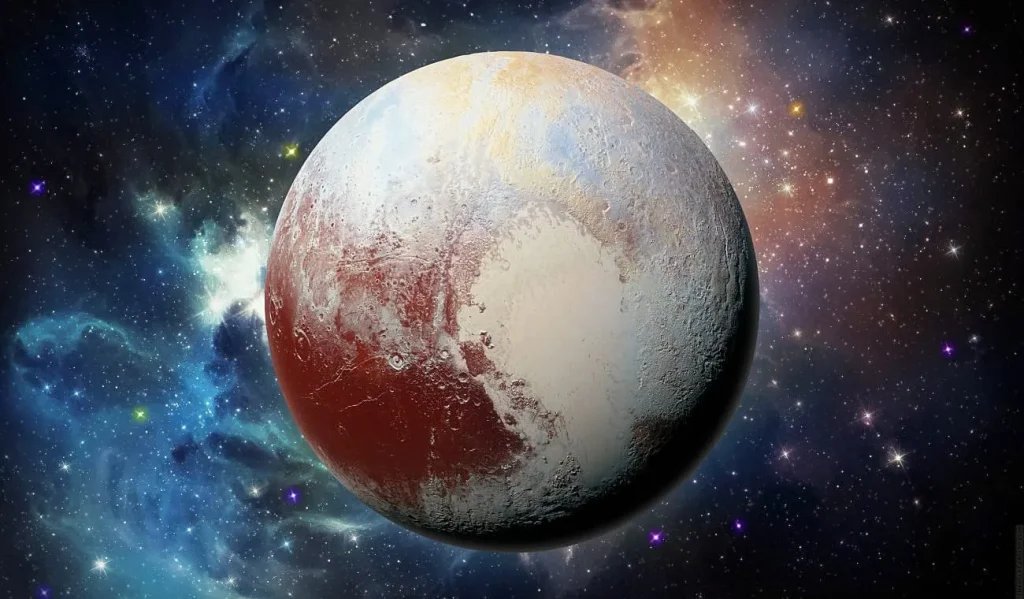
Exactly 20 years ago, on August 24, 2006, the International Astronomical Union (IAU) officially reclassified Pluto as a dwarf planet during its General Assembly in Prague, removing it from the list of major solar system planets.
Two decades later, discoveries of cryovolcanoes, an atmosphere, and glaciers made by the New Horizons spacecraft continue to spark fierce debate within the scientific community over the validity of that definition.
The Three 2006 Criteria and the Discovery of Eris
Pluto was considered the ninth planet for 76 years — ever since Clyde Tombaugh discovered it in 1930. The push to reevaluate its classification came with the discovery of numerous trans-Neptunian objects in the Kuiper Belt, including the dwarf planet Eris. Astronomers were faced with a choice: recognize dozens of newly found bodies as planets or establish a formal definition of the term.
In 2006, under the IAU resolution, a celestial body is defined as a planet if it:
- Orbits the Sun;
- Has sufficient mass to assume hydrostatic equilibrium (a nearly round shape);
- Has cleared the neighborhood around its orbit of other comparable objects.
Pluto resides in a crowded ring of icy asteroids within the Kuiper Belt and does not gravitationally dominate its orbital path, leaving the solar system with officially eight classical planets. However, only 424 delegates (fewer than 5% of the world’s professional astronomers) voted on the Pluto decision at the time, drawing immediate criticism from planetary scientists.
Geophysical Definition vs. Orbital Dynamics
The main opponent of the decision remains the science team behind the New Horizons mission, led by Alan Stern. Researchers advocate for a geophysical definition: a celestial body should be considered a planet based on its intrinsic physical properties, mass, and active geological processes, regardless of whether it has cleared its orbit.
Under this approach, not only Pluto, but also Ceres, Eris, Haumea, and Makemake would qualify as planets, expanding the solar system’s planetary roster to dozens of objects.
New Horizons Discoveries: A Dynamic World Instead of Frozen Ice
The 2015 flyby by the NASA New Horizons spacecraft revealed the extreme complexity of the celestial body. Researchers discovered water-ice mountains reaching up to 3.5 km high, convective nitrogen glaciers across the Sputnik Planitia plain in the heart-shaped Tombaugh Regio region, and a layered atmospheric haze.
In August 2026, the NASA team confirmed fresh evidence of ongoing geological activity, detecting signs of liquid nitrogen recently upwelling to the surface through cracks in the crust.
Despite the world’s geological complexity, according to official clarifications from the International Astronomical Union, there are currently no plans to revisit the 2006 resolution: to regain its status as a classical planet, Pluto still lacks the necessary mass to clear its orbital neighborhood.