









Open-Source RuView Project Turns Ordinary Wi-Fi into a Radar for Tracking People Through Walls
 ·
24.07.2026 14:13
·
2 min read
·
24.07.2026 14:13
·
2 min read
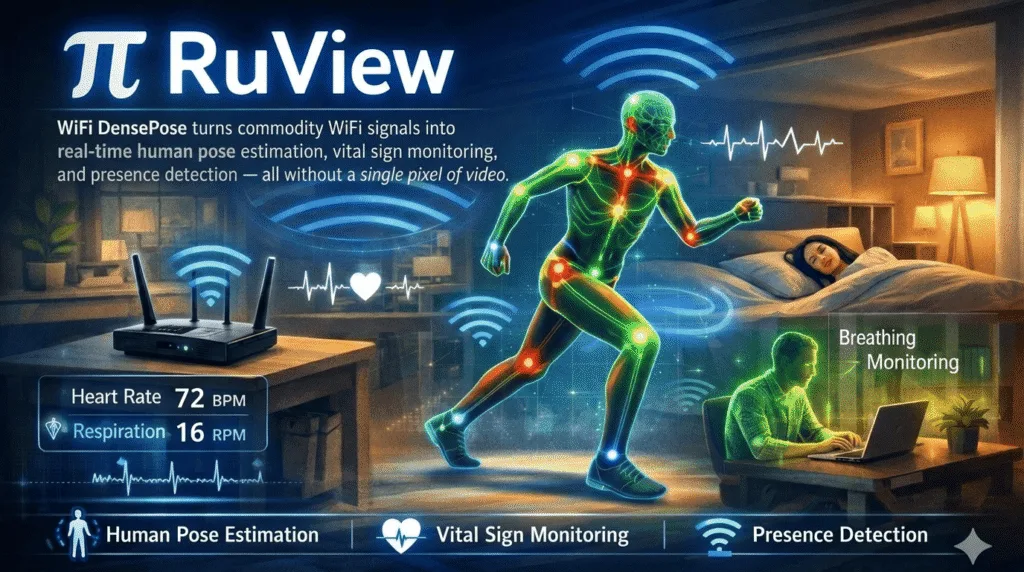
An open-source project called RuView (WiFi DensePose) is gaining popularity on GitHub, turning standard Wi-Fi equipment into a spatial reconnaissance locator. The system can detect the presence of people, track their movements, and even measure vital signs without using cameras or wearable devices.
How It Works
Instead of visual observation, the system relies on radiophysics. Any Wi-Fi router fills a room with radio waves that reflect off walls, objects, and human bodies. When a person moves, or even with microscopic chest movements, the radio frequency signals become distorted.
RuView reads CSI (Channel State Information) data using inexpensive sensors and processes it with lightweight neural network models.
Key Features
- Presence and movement detection: Determines the presence of people behind obstacles and their number in real time.
- Pose and activity recognition: The system can distinguish whether a person is standing, sitting, lying down, or has fallen (including 17-point pose “skeleton” construction).
- Vital signs monitoring: Contactless measurement of respiratory rate and tracking of heart rate dynamics during sleep or rest.
- Privacy protection: Data is processed locally without transmitting images or sound, addressing privacy concerns typical of camera-based systems.
Hardware and Availability
The main advantage of the project is the affordability of components. To build a basic node, you need a microcontroller with Wi-Fi support (such as ESP32-S3 or ESP32-C6, which cost around $10), connected to a board like a Raspberry Pi or a home server.
The project is distributed under a free license. Source code, assembly instructions, and ready-to-use model weights are published in the official RuView GitHub repository.
https://x.com/IndieDevHailey/status/2054386235867812240