








Google Maps Intentionally Lengthened Routes for Some Drivers, Cutting Traffic Delays by 4.5%
 ·
08.09.2026 11:49
·
2 min read
·
08.09.2026 11:49
·
2 min read
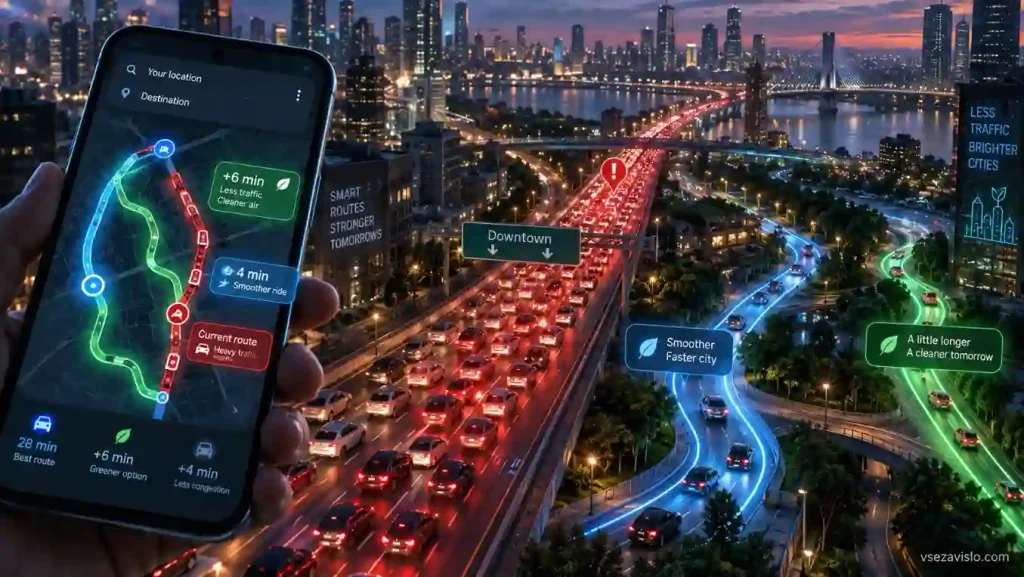
Google ran a six-month experiment across ten major US metropolitan areas, deliberately routing some drivers along alternative paths to bypass typical bottlenecks. The study affected less than 2% of all Google Maps trips, yet this targeted redistribution was enough to increase average traffic speeds and cut emissions. The researchers published their findings in the journal Nature Cities.
The Navigation Paradox and Balancing Road Networks
Standard navigation apps look for the shortest route for each individual driver. The issue arises during rush hour: when thousands of motorists receive the exact same recommendation to take the same exit, the “fastest” route instantly grinds to a halt.
As the authors explained on the Google Research blog, engineers tested the opposite approach: optimizing metropolitan traffic as a whole. At roughly one hundred critical bottlenecks in each metro area, the algorithm artificially inflated the “cost” of a congested freeway. If an alternate route existed that added only a couple of percent in travel time, the service subtly suggested it instead of the main highway.
In San Francisco, some traffic was diverted from a jammed Highway 101 onto the parallel Interstate 280, while in Atlanta, traffic was dispersed across the perimeter highway. Rerouted drivers barely noticed any difference on the timer, but motorists who stayed on the main highway saved thirty seconds or more at each bottleneck.
Test Results and Ethical Questions
The data confirmed the benefits of flexible vehicle redistribution:
- Average speeds in congested areas rose by 2%, with gains reaching 4.56% on Los Angeles interchanges;
- The average duration of all city trips dropped by 0.69%;
- Smoother traffic flow without constant braking cut fuel consumption on target segments by 0.5–1%, equivalent to reducing CO₂ emissions by more than 1,000 tons per year for each metropolitan area.
The experiment also prompted questions from journalists. As SFGATE reported, Google did not directly answer whether it notified municipal authorities or drivers about the testing. The company only stressed that drivers were always free to ignore the app’s suggestion and take their usual route.
Developers are in no rush to deploy the algorithm everywhere: they are wary of the “induced demand” effect, where temporarily cleared roads encourage more people to get behind the wheel. Even so, the trial proved that significantly easing urban highway traffic does not require redesigning interchanges—rerouting just two cars out of every hundred is enough.